5 September 2006
HUMAN RIGHTS COUNCIL
REPORT OF THE SPECIAL RAPPORTEUR ON THE SITUATION OF HUMAN RIGHTS IN THE PALESTINIAN TERRITORIES OCCUPIED SINCE 1967
Note by the Secretary-General
The Secretary-General has the honour to transmit to the members of the Human Rights Council the report on violations of international humanitarian law and human rights in the Palestinian territories occupied since 1967, submitted by John Dugard, Special Rapporteur, pursuant to Human Rights Council decision 1/106.
The Secretary-General draws the attention of the members of the Human Rights Council to the fact that this report is based on a visit undertaken by the Special Rapporteur from 9 to 17 June 2006, prior to the adoption of the above-mentioned decision by the Council.
Summary
The central feature of this report is the conflict in and the siege of Gaza. On 25 June 2006, following the capture of Corporal Gilad Shalit by Palestinian militants and the continued firing of home-made Qassam rockets into Israel, Israel commenced repeated military incursions into Gaza and regular shelling of Gaza, causing numerous deaths and injuries, destruction of homes, agricultural land and infrastructure and resulting in the large-scale violation of human rights and international humanitarian law. In particular, Israel has violated the prohibition on the indiscriminate use of military power against civilians and civilian objects. The situation in the West Bank has also deteriorated substantially.
The Wall presently under construction in the Palestinian territory is now portrayed by the new Government of Israel as a political measure designed to annex 10 per cent of Palestinian land situated between the Green Line and the Wall, where some 76 per cent of the Israeli settler population lives. When the Wall is completed, an estimated 60,500 West Bank Palestinians living in 42 villages and towns will be enclosed in the closed zone between the Wall and the Green Line. The 500,000 Palestinians living near the Wall require permits to cross it, and it is estimated that 40 per cent of the applications for permits are refused.
Israel continues its policy of the de-Palestinization of Jerusalem. The Wall is constructed in such a way as to place about a quarter of East Jerusalem’s Palestinian population of 230,000 in the West Bank. Such persons will in future require permits to access their employment and to visit friends, hospitals and religious sites in Jerusalem.
Settlements continue to expand, in violation of the Fourth Geneva Convention. The settler population in the West Bank and East Jerusalem now numbers over 440,000.
The low wall under construction in south Hebron will make it difficult for Palestinian communities located between the low wall and the Green Line to access their lands, schools and clinics.
The number of checkpoints has increased, from 376 in August 2005 to over 500. Permits for travel between different parts of the West Bank are granted sparingly and require Palestinians to subject themselves to arbitrary bureaucratic procedures. Nablus and Jenin, in particular, have been seriously affected by checkpoints, and are today in effect imprisoned cities. It seems that the main purpose of many checkpoints is to make Palestinians constantly aware of Israeli control of their lives and to humiliate them in the process.
The demolition of houses remains a regular feature of the occupation. It has now become the practice to destroy houses in the course of effecting arrests in policing operations. The destruction of houses for reasons other than military necessity is prohibited by international humanitarian law.
The family life of Palestinians is undermined by a number of Israeli laws and practices. Recently, the Israeli High Court upheld a law which prohibits Israeli Arabs who marry Palestinians from living together with them in Israel. The Wall in Jerusalem has also resulted in the separation of families.
More than 10,000 Palestinians, including women and children, are imprisoned in Israeli jails.
The humanitarian situation in both the West Bank and Gaza is appalling. At least 4 out of 10 Palestinians live under the official poverty line of less than US$ 2.10 a day and unemployment stands at least 40 per cent. To aggravate matters, the public sector, which accounts for 23 per cent of total employment in the Palestinian territory, is employed but unpaid as a result of the withholding of funds owed to the Palestinian Authority by the Government of Israel, amounting to $50 to 60 million per month. In addition, the United States and the European Union have cut off funds to the Palestinian Authority on the ground that Hamas, the party elected to Government in January 2006, is listed under their laws as a terrorist organization. Non-governmental organizations working with the Palestinian Authority have likewise been affected by restrictions on funding.
In effect, the Palestinian people have been subjected to economic sanctions - the first time an occupied people have been so treated. This continues, despite the fact that Israel is itself in violation of numerous Security Council and General Assembly resolutions and has failed to implement the advisory opinion of the International Court of Justice of 9 July 2004.
The Quartet itself has no regard for the advisory opinion and fails even to refer to it in its public utterances. This has substantially undermined the reputation of the United Nations in the Occupied Palestinian Territory. Although Palestinians have a high regard for dedicated and committed United Nations workers on the ground, they have serious misgivings about the role of the United Nations in New York and Geneva.
CONTENTS
Paragraphs
I. INTRODUCTION
II. THE QUESTION OF OCCUPATION
III. THE PRESENT CRISIS IN GAZA
A. Bombardment of public utilities
B. Bombardment of public buildings and facilities
C. Closure of borders
D. Casualties
E. Military incursions causing death & destruction
F. Shelling and sonic booms
G. Targeted assassinations
H. Terrorism by telephone
I. Hospitals and health
J. Food and poverty
K. Legal assessment of Israeli action
IV. THE WEST BANK
V. JERUSALEM AND THE WALL
VI. SETTLEMENTS
VII. SOUTH HEBRON AND THE “MINI-WALL”
VIII. THE JORDAN VALLEY
IX. HOUSE DEMOLITIONS
X. CHECKPOINTS
XI. SEPARATION OF FAMILIES
XII. ADMINISTRATION OF JUSTICE
XIII. THE HUMANITARIAN CRISIS AND FUNDING OF
THE PALESTINIAN AUTHORITY
XIV. THE ADVISORY OPINION OF THE INTERNATIONAL
COURT OF JUSTICE AND THE UNITED NATIONS
XV. CONCLUSION
I. INTRODUCTION
1. I visited the Occupied Palestinian Territory (OPT) and Israel from 9 to 17 June 2006 in order to compile information for my report to the Human Rights Council at its forthcoming session in September 2006. Shortly after I left OPT a serious crisis erupted in Gaza following the capture by Palestinian militants of an Israeli soldier, Corporal Gilad Shalit. The Israeli reaction to this development prompted the convening of a special session of the Council to discuss the situation in OPT. At the special session, held on 5 and 6 July 2006, the Council decided to send a fact-finding mission headed by myself to OPT so that I might report on the most recent developments. In order to carry out this mission it was necessary to obtain the consent of the Government of Israel. The Government, however, declined to agree to a visit by the fact-finding mission. The present report is therefore written to apprise the Council of the situation affecting human rights in the region in the context of my visit and subsequent developments in OPT which gave rise to the request for a fact-finding mission. Inevitably, as I was not able to visit the region in July, information on these developments up to 9 August 2006 has been obtained from secondary sources - press reports, reports of non-governmental organizations (NGOs), United Nations publications, etc.
2. During my mission I visited Jerusalem, Gaza, villages in the vicinity of Jerusalem which have been seriously affected by the construction of the Wall, Ramallah, Hebron and communities in the South Hebron Hills, Bethlehem and the Wall near Rachel’s Tomb, the village of Wallaja, where house demolitions have occurred, the Jordan Valley, including Jericho, and communities whose human rights are affected by Israeli policies and practices, Nablus, including the Balata refugee camp, the village of Jayyous on the perimeter of the Wall and farming communities living close to the Wall, and checkpoints around the city of Nablus and roads in its vicinity.
3. During the visit I spoke with a wide range of persons, both Palestinian and Israeli, about violations of human rights and international humanitarian law. I delivered a lecture at the Hebrew University in Jerusalem sponsored by the Minerva Centre for Human Rights and the International Committee of the Red Cross (ICRC). The lecture, which was attended by more than 100 persons, examined controversial questions of humanitarian law relating to the conflict in OPT. Unfortunately, I had no contact with Israeli officials as the Government of Israel does not recognize my mandate. The Government was, however, aware of my visit and placed no obstacles in the way of the visit.
4. The eruption of violence in Gaza following the capture of Corporal Shalit and the arrest of members of the Palestinian Legislative Council and the Palestinian Authority (see paragraph 11 below) was followed by Israel’s invasion of Lebanon and large-scale violence in Lebanon, Israel and Gaza. It is not the purpose of this report to comment on events in Lebanon and along Israel’s northern borders, as that falls outside my mandate. It will, however, fully examine the situation in Gaza. It should be mentioned that the events in Lebanon to a large extent have overshadowed violence in Gaza and along its borders.
5. In the present report “the Wall” is used instead of “barrier” or “fence”. This term was carefully and deliberately used by the International Court of Justice in its 2004 advisory opinion on the Legal Consequences of the Construction of a Wall in the Occupied Palestinian Territory of 9 July 2006. I see no reason to depart from this language.
II. THE QUESTION OF OCCUPATION
6. Before turning to the substance of my report, there is a preliminary matter of concern which I wish to address. This is the question of occupation. The Government of Israel prefers to avoid acknowledging the fact that OPT, that is both the West Bank and Gaza, including East Jerusalem, is occupied territory. Instead, it prefers to speak about the “disputed territories” and to assert that the withdrawal of settlers and the Israel Defence Forces (IDF) from Gaza in August 2005 has terminated the occupation of Gaza. This is a misconception of both law and fact. The International Court of Justice, the Security Council and the High Court of Israel itself have all asserted that OPT is and remains occupied territory and that, as such, it is governed by a special legal regime. According to this regime, Israel is bound to comply with both international humanitarian law and human rights law in its treatment of Palestinians. It is, admittedly, an unusual occupation in that it has continued for almost four decades. The protracted nature of the occupation does not, however, reduce the responsibility of the occupying Power. On the contrary, it increases its responsibility. The length of the occupation has led some to characterize the situation as one of colonialism or apartheid. Although Israel’s conduct at times resembles that of a colonial Power or an apartheid regime, it is more correct to classify Israel as an occupying Power in OPT and to judge its actions in accordance with the international law rules applicable to occupation.
III. THE PRESENT CRISIS IN GAZA
7. The question whether Gaza remains an occupied territory is now of academic interest only. In the course of the cynically named “Operation Summer Rains” IDF has not only asserted its control in Gaza by means of heavy shelling, but has also done so by means of a military presence.
8. In August 2005 Israel withdrew its settlers and armed forces from Gaza. Statements by the Government of Israel that the withdrawal ended the occupation of Gaza are grossly inaccurate. Even before the commencement of “Operation Summer Rains”, Gaza remained under the effective control of Israel. This control was manifested in a number of ways. First, Israel retained control of Gaza’s air space, sea space and external borders. Although a special arrangement was made for the opening of the Rafah crossing to Egypt, to be monitored by European Union personnel, all other crossings remained largely closed. The closure of the Karni crossing for goods for substantial periods had particularly serious consequences for Gaza as it resulted in a denial of access to foodstuffs, medicines and fuel. A proposed scheme which would have allowed Gazans to visit family in the West Bank by means of bus convoys was never implemented. In effect, following Israel’s withdrawal Gaza became a sealed off, imprisoned society. The effectiveness of Israel’s control was further demonstrated by sonic booms caused by its overflying aircraft, designed to terrorize the population of Gaza, regular shelling of homes and fields along the border and targeted assassinations of militants, which, as in the past, were carried out with little regard for innocent civilian bystanders. In one incident in June 2006, a family of seven was killed by IDF shelling while picnicking on a Gaza beach. The actions of IDF in respect of Gaza have clearly demonstrated that modern technology allows an occupying Power to effectively control a territory even without a military presence.
9. Writing in Haaretz on 7 July 2006, the Israeli columnist Gideon Levy summed up the situation in the following language:
“The Israel Defence Forces departure from Gaza … did almost nothing to change the living conditions for the residents of the Strip. Gaza is still a prison and its inhabitants are still doomed to live in poverty and oppression. Israel closes them off from the sea, the air and land, except for a limited safety valve at the Rafah crossing. They cannot visit their relatives in the West Bank or look for work in Israel, upon which the Gazan economy has been dependent for some forty years. Sometimes goods can be transported, sometimes not. Gaza has no chance of escaping its poverty under these conditions. Nobody will invest in it, nobody can develop it, nobody can feel free in it. Israel left the cage, threw away the keys and left the residents to their bitter fate. Now, less than a year after the disengagement, it is going back, with violence and force.”
10. Even before the start of “Operation Summer Rains” Israel had already tightened its control of Gaza in response to the election of Hamas to the Palestinian Authority in January 2006. I visited Gaza on 11 June 2006. For security reasons, I was not permitted to stay overnight, as had previously been my practice during visits to OPT. I visited the Al Aqsa Martyrs Hospital in Gaza and spoke with the director of hospital services and senior medical practitioners. It was clear that the hospital services faced a crisis resulting from the non payment of staff salaries and the restrictions placed on the supply of medicines and vaccines through the Karni crossing. It seemed clear to me that the Government of Israeli had embarked upon a siege in order to bring about regime change. In the process little attention was being paid to human rights, as shelling and sonic booms violated the fundamental rights to life and human dignity, and even less attention was paid to the constraints of international humanitarian law; it was already clear that collective punishment was to be the instrument used to bring about regime change.
11. On 25 June 2006 a group of Palestinian militants attacked a military base near the Israeli Egyptian border, which left two Palestinians and two IDF soldiers dead. In retreating, they took Corporal Gilad Shalit with them as captive. They demanded the release of the women and children in Israeli jails in return for his release. This act, together with the continued Qassam rocket fire into Israel, unleashed a savage response from the Government of Israeli. In the first place, it arrested 8 Hamas Cabinet ministers and 26 members of the Palestinian Legislative Council in Ramallah. At the time of writing this report, most of them remained in detention. While Israel claims that they are being held because of their support for terrorist activities, it is difficult to resist the notion that they are being held as hostages, in violation of article 34 of the Geneva Convention relative to the Protection of Civilians in Time of War (Fourth Geneva Convention). This impression is confirmed by the debate within the Government over what to do with them. The Shin Bet security service suggested holding them as bargaining chips under the Unlawful Combatants Law. It seems, however, that the Attorney-General, Menachem Mazuz, has insisted that legal proceedings be initiated against them for membership in a terrorist organization (see Haaretz, 30 June 2006). The issue of the arrest of members of Hamas has been aggravated by the arrest of Aziz Dweik, Speaker of the Palestinian Legislative Council, on 5 August 2006 and reports that he has been injured in the course of interrogation.
12. Israel’s assault on and siege of Gaza in the course of “Operation Summer Rains” has taken many forms, described in the following paragraphs.
A. Bombardment of public utilities
13. On 28 June 2006 the Israeli Air Force (IAF) destroyed all six transformers of the only domestic power plant in the Gaza Strip. This plant supplied 43 per cent of Gaza’s daily electricity. The rest is provided by the Israel Electrical Corporation. Approximately 700,000 Gazans, out of a population of 1.4 million, initially were without electricity. Currently, the Gaza Electrical Distribution Company (GEDCO) is load-sharing the remaining electricity supply from Israel, but the supply of power to households across the Gaza Strip is intermittent. As most of Gaza’s water wells are powered through the national electrical grid, which has been destroyed, generators are being used to power wells, and the daily water supply to Gazan households has been reduced. Israel’s military operations have also destroyed the main water pipelines and sewerage networks. In addition, the frequent closure of the Nahal Oz pipeline, the only pipeline bringing fuel into the Gaza Strip, has affected the use of backup generators to power regular water supplies.
14. On 19 July IAF bombed power transformers during an attack on the el Maghazi refugee camp, cutting off power to the whole of the central Gaza Strip.
15. The substantial reduction of the electricity and fuel supply, together with the disruption of water supplies, has impacted severely on the daily life of Palestinians who are without light at night and electricity to do their cooking. Moreover, it is impossible to pump water to the upper levels of multi-storey buildings. The sewers threaten to overflow. Hospitals have been radically affected and are forced to use generators to power life-saving equipment because of power outages.
B. Bombardment of public buildings and facilities
16. Israeli war planes have deliberately targeted public buildings in Gaza. The buildings housing the Ministries of the Interior, Foreign Affairs and the National Economy and the Office of the Prime Minister have all been destroyed. Such action serves no security purpose and can only be construed as an attempt to undermine the institutions of Government. Educational institutions have also been destroyed. Six bridges linking Gaza City with the central Gaza Strip have been destroyed, as have a number of roads. On 28 June IDF occupied Gaza International Airport and destroyed large parts of it.
C. Closure of borders
17. Although the Rafah crossing is not directly controlled by Israel, IDF prevented European observers responsible for staffing the crossing from reaching it. It has, therefore, been closed since 25 June, only opening for two brief periods. The closure of the Rafah crossing for three weeks in July 2006 left more than 3,000 Palestinians stranded on the Egyptian side of the border in harsh conditions, including some 578 people deemed to be “urgent humanitarian cases”, who had been referred for medical treatment abroad. Eight Palestinians died as a result of their being denied proper medical treatment, shelter and water at the crossing.
18. The closure of the Rafah crossing has also had serious consequences for Palestinians on the Gaza side, particularly those living abroad who were in Gaza for family visits. Serious questions arise about the role of the EU monitors in this connection. They are in charge of the supervision of the crossing under the terms of an agreement of 15 November 2005 between the Palestinian Authority and Israel, an agreement facilitated by the United States. It is surely incumbent upon the EU monitors to show some courage and compassion in carrying out their supervisory role and not simply to bow to the dictates of the Government of Israel.
19. The Karni commercial crossing has been intermittently closed. The import of some food and medical supplies to Gaza has been permitted but the export of goods has been severely curtailed.
20. Israeli naval vessels have prevented Palestinian fishing along the coast, with the result that fish is no longer available in local markets.
D. Casualties
21. Since 25 June 2006 some 184 Palestinians (at least half of whom were civilians) have been killed, including 42 children. Some 720 people have been seriously wounded, including 168 children and 21 women. One Israeli soldier has been killed and 25 Israelis injured, including 11 injured by home-made rockets fired from Gaza.
E. Military incursions causing death and destruction
22. Since 25 June 2006 IDF has made numerous and repeated incursions into the Gaza Strip, killing civilians and destroying houses. The most serious incursions have been into Beit Hanoun, Beit Lahia, Sajiyeh, Deir el-Balah, the el-Maghazi refugee camp, Rafah and Khan Younis. In the course of these raids, carried out by tanks and bulldozers, houses have been seized and transformed into military bases. These houses have been severely damaged and several hundred houses have been destroyed. Schools run by the United Nations Relief and Works Agency for Palestine Refugees in the Near East (UNRWA) have been attacked and damaged. Olive and citrus trees have been uprooted and farmland destroyed in land levelling operations. Roads, water pipes and electricity and telephone poles have been damaged. Many families have been compelled to flee their houses, and it is estimated that some 3,400 Palestinians are presently being sheltered by UNRWA as a result of the military action. Despite the prohibition on the use of civilians as human shields imposed by the High Court of Israel, IDF has detained civilians and used them as human shields during bulldozing and detention operations. Military incursions have been accompanied by heavy shelling and the bombing of houses, resulting in the death of many civilians.
23. The attacks on the el-Maghazi refugee camp from 19 to 21 July 2006 and the attack on Rafah at the beginning of August are examples of typical Israeli incursions. In the first, 19 Palestinians were killed, including 4 children and 1 woman, and 125 were injured, most of them unarmed civilians. Four houses were completely destroyed and nine were partially destroyed. In addition, agricultural crops were levelled and the electrical, water and road infrastructure was destroyed. In the second incursion, 16 Palestinians were killed, including 10 civilians, and 39 were injured by shrapnel and suffered burns; 4 children were killed and 13 injured.
24. There has been heavy fighting between Palestinian militants and IDF. IDF has used tanks and bulldozers, supported by helicopters that have fired flares and machine guns to provide cover for ground forces.
F. Shelling and sonic booms
25. Israel has maintained unrelenting shelling of the Gaza Strip since 25 June. Several thousand shells have been fired, an estimated 200-250 each day. IAF had conducted at least 220 aerial bombings as of 3 August and fighter jets have fired air-to-surface missiles. This has been accompanied by F-16s flying low and breaking the sound barrier over Gaza, causing sonic booms that are as loud as the actual bombardments. These sonic booms have caused widespread terror among the population, particularly children. If terrorism has any meaning, then it is surely this. A doctor from Gaza has written about the effects of sonic booms and artillery shelling on her 13 year-old daughter in the following words:
“My daughter is restless, panicked and afraid to go out, yet frustrated because she cannot see her friends. When Israeli fighter planes fly by day and night, the sound is terrifying. My daughter usually jumps into bed with me, shivering with fear. Then both of us end up crouching on the floor. My heart races, yet I try to pacify my daughter, to make her feel safe. But when the bombs sound, I flinch and scream. My daughter feels my fear and knows that we need to pacify each other. I am a doctor, and mature, middle-aged woman, but with sonic booming, I become hysterical” (Dr. Mona El-Farra, The Boston Globe, 10 July 2006).
26. Palestinians are not blameless when it comes to shelling. Militants continue to fire Qassam home-made rockets indiscriminately into Israel, injuring Israeli civilians, damaging civilian infrastructure and causing fear among the civilian population living near the Gaza border. It is estimated that eight to nine rockets are fired each day.
G. Targeted assassinations
27. Targeted assassinations have continued, with the inevitable “collateral damage” to civilians.
H. Terrorism by telephone
28. The Israeli military has now resorted to a new method of psychological terror. Palestinians in Gaza are telephoned by Israeli military intelligence agents and warned that their houses will be blown up in less than one hour. This threat is sometimes carried out and sometimes not. This tactic has inevitably caused psychological distress and panic amongst Palestinians. Palestinians forced to leave their homes in this way have become internally displaced persons forced to live in UNRWA school premises.
I. Hospitals and health
29. Israeli forces demolished the outside wall of the new emergency hospital in Beit Hanoun. Nevertheless, the hospital continues to function but is seriously impaired. Generators are being used to operate X-ray departments and operation theatres. Referrals abroad of patients from the
Gaza Strip have been severely affected by the present crisis. As noted above, checkpoints have been closed to patients and permits denied. Particularly serious problems have arisen in respect of the Rafah border crossing to Egypt. Essential drugs are also in short supply. On 27 July the Palestinian Authority Ministry of Health reported that 67 of the 473 items on the list of essential drugs were out of stock.
30. Public health is endangered by lack of safe drinking water and sewage leakage and reported cases of diarrhoea have increased by 163 per cent compared with the same period last year. It is feared that communicable diseases like cholera and poliomyelitis will reappear.
31. Many Palestinians have suffered burns concentrated on the lower body, which has resulted in a high number of amputations. The Palestinian Health Ministry has called for an independent inquiry into this phenomenon.
J. Food and poverty
32. The poverty level in Gaza stands at 75 per cent. This is mainly attributable to the siege. Food insecurity results in part from the absence of purchasing power as few people have sufficient money today to cover their family’s basic food needs. Food prices have inflated and supplies have been reduced as a result of the current operation. As noted above, fish is no longer available as a result of the sea blockade. Wheat flour mills, factories producing food and bakeries have been forced to reduce their production owing to power shortages. Furthermore, the loss of capacity to preserve perishable food in the Gaza heat results in high food losses. Supplies of sugar, dairy products and milk are running extremely low as commercial supplies from Israel are limited.
33. As indicated above, water supplies have been seriously affected as a result of the destruction of the Gaza power plant and the bombing of pipelines. Consequently, drinking water is in short supply. UNRWA and ICRC have been compelled to supply water by means of water tankers.
K. Legal assessment of Israeli action
34. Israel’s actions must be assessed in terms of both human rights norms and international humanitarian law. According to the International Court of Justice in its advisory opinion cited above, both these regimes are applicable to Israel’s conduct in the Occupied Palestinian Territory.
35. Israel has violated a number of rights proclaimed in the International Covenant on Civil and Political Rights, particularly the right to life (art. 6), freedom from torture, inhuman or degrading treatment (art. 7), the freedom from arbitrary arrest and detention (art. 9), freedom of movement (art. 12) and the right of children to protection (art. 24). It has also violated rights contained in the International Covenant on Economic, Social and Cultural Rights, notably “the right of everyone to an adequate standard of living for himself and for his family, including adequate food, clothing and housing”, freedom from hunger, and the right to food (art. 11) and the right to health (art. 12).
36. Israel has, in addition, violated the most fundamental rules of international humanitarian law, which constitute war crimes in terms of article 147 of the Fourth Geneva Convention and article 85 of the Protocol Additional to the Geneva Conventions of 12 August 1949, and relating to the Protection of Victims of International Armed Conflict (Protocol I). These include direct attacks against civilians and civilian objects and attacks which fail to distinguish between military targets and civilians or civilian objects (arts. 48, 51 (4) and 52 (1) of Protocol I); the excessive use of force arising from disproportionate attacks on civilians and civilian objects (arts. 51 (4) and 51 (5) of Protocol I); the spreading of terror among the civilian population (art. 33 of the Fourth Geneva Convention, and art. 51 (2) of Protocol I) and the destruction of property not justified by military necessity (art. 53 of the Fourth Geneva Convention). Above all, the Government of Israel has violated the prohibition on collective punishment of an occupied people contained in article 33 of the Fourth Geneva Convention. The indiscriminate and excessive use of force against civilians and civilian objects, the destruction of electricity and water supplies, the bombardment of public buildings, the restrictions on freedom of movement and the consequences that these actions have had upon public health, food, family life and the psychological well-being of the Palestinian people constitute a gross form of collective punishment. The capture of Corporal Gilad Shalit and the continued firing of Qassam rockets into Israel cannot be condoned. On the other hand, they cannot justify the drastic punishment of a whole people in the way that Israel has done.
IV. THE WEST BANK
37. Many of Israel’s policies and practices in the West Bank seriously impinge upon the human rights of Palestinians. The Wall presently under construction in Palestinian territory, checkpoints and roadblocks, settlements, an arbitrary permit system, the pervasive practice of house demolitions, targeted assassinations, and arrests and imprisonment violate a wide range of civil and political rights. Economic and social rights have also suffered from the humanitarian crisis resulting from the occupation.
The Wall
38. The Wall that Israel is presently building largely in Palestinian territory is clearly illegal. The International Court of Justice in its advisory opinion 4 asserted that it is contrary to international law and that Israel is under obligation to discontinue construction of the Wall and to dismantle those sections that have already been built forthwith. On 20 July 2004 the General Assembly adopted resolution ES-10/15 by 150 votes in favour, 6 against and 10 abstentions, in which it demanded that Israel comply with its legal obligations identified in the advisory opinion. The Israeli High Court of Justice, in a judgement delivered in September 2005 in Mara’abe v. the Prime Minister of Israel (HCJ 7957/04), dismissed the advisory opinion, arguing that the International Court of Justice had failed to have regard to the security considerations that had prompted the construction of the Wall. The basis of this judgement has now been undermined by the admission of the Israeli Government that the Wall is designed to serve a political purpose and not an exclusively security purpose. The admission that the Wall has in part been built to include West Bank settlements within the Wall and under Israel’s direct protection has led the High Court to rebuke the Government for misleading it in the Mara’abe hearing and other challenges to the legality of the Wall (see Haaretz, 14 and
16 June 2006). That the purpose of the Wall is to acquire land surrounding West Bank settlements and to include settlements themselves within Israel can no longer be seriously challenged. The fact that 76 per cent of the West Bank settler population is enclosed within the Wall bears this out. The Government’s present policy to unilaterally disengage from the West Bank or to realign Israel’s borders is a thin disguise for the annexation by Israel of the territory between the Green Line and the Wall, amounting to some 10 per cent of Palestinian land.
39. On 30 April 2006 the Israeli Government revised the route of the Wall. It will now be 703 km long when completed, rather than 670 km. At present over 50 per cent of the Wall has been completed. When it is finished, an estimated 60,500 West Bank Palestinians living in 42 villages and towns will reside in the closed zone between the Wall and the Green Line. More than 500,000 Palestinians living within 1 km of the Wall live on the eastern side but need to cross it to get to their farms and jobs and to maintain family connections. Eighty per cent of the Wall is built within the Palestinian territory itself and in order to incorporate the Ariel settlement block, it extends some 22 km into the West Bank. At present, there are some 73 gates in the Wall, but only 38 of them are accessible to Palestinians, and only to those with the correct permit.
40. A host of obstacles are placed in the way of obtaining a permit. Bureaucratic procedures for obtaining permits are humiliating and obstructive. Although precise figures are not available, it seems that the number of permits refused may conservatively be estimated at 40 per cent. Reasons given for refusing permits range from security to failure to establish land ownership. The latter ground is now more frequently used by Israeli authorities as it has become clear that Palestinians, whose land ownership dates from a chaotic Ottoman system of land tenure, are frequently unable to prove ownership to the satisfaction of Israeli authorities determined to deny permits. The difficulties and humiliation occasioned by the process of applying for permits furthermore deters many Palestinians from applying. The fact that the opening and closure of gates leading to the closed zone are regulated in a highly arbitrary manner and frequently do not open as scheduled aggravates the situation. Moreover, tractors and farm vehicles are frequently not allowed access to the closed zone, which means that farmers must walk or use donkeys to reach their land and to bring out their produce.
41. Obstacles placed in the way of access to the closed zone have seriously affected farming in this zone. At a time when many Palestinians are returning to the land as a result of the non payment of salaries to civil servants and the closure of many private businesses in the cities, the permit system seriously impacts upon Palestinian employment and livelihood.
V. JERUSALEM AND THE WALL
42. At the outset of this discussion it is necessary to repeat that East Jerusalem is not part of Israel. It is occupied territory subject to the Fourth Geneva Convention. This obvious truth was noted by the International Court of Justice in its advisory opinion. Israel’s illegal attempt at annexation of East Jerusalem must not be allowed to obscure this fact.
43. The 75 km Wall around Jerusalem (of which only 5 km are on the Green Line) is the instrument being used to effect major changes in the city by seeking to ensure that Jerusalem
assumes a predominantly Jewish character, which will undermine Palestinian claims to Jerusalem as the capital of an independent Palestinian State. This is being done by constructing the Wall through Palestinian neighbourhoods in East Jerusalem and classifying neighbourhoods on the eastern side of the Wall as belonging to the West Bank. This has serious implications for the human rights of some 230,000 Palestinians living in Jerusalem.
44. First, while Palestinians living on the west side of the Wall will be allowed to retain their Jerusalem identity documents, which entitle them to certain benefits, particularly in respect of social security, they will find it increasingly difficult to travel to cities in the West Bank such as Ramallah and Bethlehem, where many of them are employed. Moreover, if they elect to reside in the West Bank in order to be nearer to their places of work, they risk losing their Jerusalem identity documents and the right to live in Jerusalem because under Israel’s so-called centre of life policy, Palestinians must prove that they currently live in the city of East Jerusalem to maintain their Jerusalem residency rights.
45. Secondly, those relegated to the West Bank as a result of the construction of the Wall, who number about a quarter of the city’s population of 230,000, will lose their Jerusalem identity documents and the attendant benefits. They will also require a permit to enter Jerusalem, and will be allowed to enter the city by only 4 of the 12 crossings in the Wall, which will considerably increase their commuting time and impede their access to schools, universities, hospitals, religious sites and places of employment.
46. The construction of the Wall in order to achieve the Judaization of Jerusalem is a cynical exercise in social engineering that imposes severe hardships on all aspects of Palestinian life.
VI. SETTLEMENTS
47. Jewish settlements in the West Bank are illegal. They violate article 49, paragraph 6, of the Fourth Geneva Convention and their illegality has been confirmed by the International Court of Justice in the advisory opinion on the Wall. The Israeli High Court has consistently refused to pronounce on the legality of settlements, which indicates that even Israel’s own High Court is unwilling to confer legitimacy on settlements.
48. Despite the illegality of settlements and the unanimous condemnation of settlements by the international community, the Israeli Government persists in allowing settlements to grow. Sometimes settlement expansion occurs openly and with the full approval of the Israeli Government. For instance, in 2006 the Government approved the expansion of the settlements of Givat Ze’ev, Kfar Sava, Maskiyot and Beitar Ilit (see Haaretz, 21 May 2006). More frequently, expansion takes place stealthily under the guise of “natural growth”, which has resulted in Israeli settlements growing at an average rate of 5.5 per cent compared with the average growth rate in Israeli cities of 1.7 per cent. Sometimes settlements expand unlawfully in terms of Israeli law, but no attempt is made to enforce the law. Outposts are frequently established and threats to remove them are not carried out.
49. As a result of this expansion, the settler population in the West Bank numbers some 245,000 persons and that of East Jerusalem nearly 200,000. As indicated above, the Wall is presently being built in both the West Bank and East Jerusalem to ensure that most settlements
will be enclosed within the Wall. Moreover, the three major settlement blocks of Gush Etzion, Ma’aleh Adumim and Ariel will effectively divide Palestinian territory into cantons, thereby destroying the territorial integrity of Palestine.
50. It is clear from statements of the Government of Israel that the major settlement blocks are destined to remain part of Israel. On 3 May 2006 Prime Minister Olmert told the Knesset that “The achievements of the settlement movement in main concentrations will forever be an integral part of the sovereign state of Israel, along with Jerusalem our united capital” (see Haaretz, 4 May 2006).
51. The Israeli Government’s proposed policy of “unilateral disengagement”, “convergence” or “realignment” clearly envisages the unlawful annexation of large portions of Palestinian territory. The euphemisms used to describe this policy should not be allowed to obscure this hard truth.
52. Settler violence continues to be a serious problem. In June 2006 the Palestinian Monitoring Group published the following account of settler violence which is illustrative of the problem:
“Israeli settlers attempted to abduct a female university student in the district of Salfit; beat civilians in the city of Hebron as well as other civilians near the settlement of Ma’on; closed a road in the district of Qalqiliya; threw stones at civilian houses in Tel Rumeida neighbourhood in the city of Hebron, and stole a water pump from a house in Tel Rumeida. They burned two civilian vehicles and one truck in the town of Huwara; set fire to wheat crops and olive trees in the villages of Salim near Nablus and Al Jab’a near Bethlehem; and grazed sheep on cultivated land in the district of Hebron.”
VII. SOUTH HEBRON AND THE “MINI-WALL”
53. Plans to build the Wall in south Hebron have been abandoned. Instead, the projected Wall will largely follow the Green Line. In its place Israel is constructing a “mini-wall” running along the northern side of settler bypass roads in the region. This wall is approximately 1 m high and is designed to prevent Palestinian vehicles from crossing onto the main road and to give settlers unrestricted use of bypass roads. These restrictions will allow Jewish settlers to move safely between settlements and further on to Israel without crossing Palestinian land. Twenty two Palestinian communities and over 1,900 Palestinians will be enclosed between the road barrier or mini-wall and the Wall, at present being constructed along the Green Line. The mini-wall will hinder the access of Palestinian shepherds and their 24,000 head of livestock to grazing areas on the other side. The mini-wall will add to the hardships already experienced by Palestinian communities living in south Hebron, which has inadequate clinics, schools and waste supplies; water must be trucked in when summer begins and rain-fed systems start emptying. The Israeli Government has refused to link Palestinian communities to its water system, which provides water to settlers alone. To aggravate the situation, the Israeli Government refuses permits to build houses.
54. The plight of Palestinian communities in south Hebron is illustrated by the experience of the village of Tuwani, which I have visited on several occasions. This village is denied electricity, water and sanitary units and is prohibited from building new houses. Moreover, the villagers are subjected to settler violence from nearby Ma’on. Schoolchildren have to be escorted by IDF to school in order to protect them from the settlers. The settlers are also responsible for poisoning the land.
VIII. THE JORDAN VALLEY
55. Israel has abandoned earlier plans to build the Wall along the spine of OPT and to formally appropriate the Jordan Valley in the same way as it has done along the western border of OPT. But it has asserted its control over this region, constituting 25 per cent of the West Bank, in much the same way as it has done over the closed zone between the Wall and the Green Line on Palestine’s western border. The intention of Israel to remain permanently in the Jordan Valley is clear from government statements and is further manifested, first, by restrictions imposed on Palestinians and, second, by Israeli control and the increase in the number of settlements in the Jordan Valley.
56. Palestinians living in the Jordan Valley must possess ID cards with a Jordan Valley address. Only such persons may travel within the Jordan Valley without Israeli permits. Other Palestinians, including non-resident landowners and workers, must obtain permits to enter the Jordan Valley and in practice such permits are not valid for overnight stays, thereby necessitating daily commuting and delays at checkpoints connecting the Jordan Valley with the rest of the West Bank. This has led to the isolation of the Jordan Valley. Travel restrictions make it difficult for farmers in the Jordan Valley to access markets in the West Bank as their produce is frequently held up at checkpoints and perishes in the process. Attempts to sell such produce along the roadside have failed as a result of the destruction of agricultural stalls along the road by IDF.
57. Most of the land in the Jordan Valley is controlled by Jewish settlements or used as military zones. Only 4 per cent of the Valley is accessible to 47,000 Palestinians for agricultural and residential use. There are some 8,300 settlers living in the Jordan Valley and their number is growing as a result of the resettlement of settlers from Gaza. Whereas Palestinians are without electricity and water in most villages, settlers are linked to Israel’s electricity and water systems. Moreover the 8,300 settlers living in the Jordan Valley consume more water each year than the 47,000 Palestinians living in the region.
IX. HOUSE DEMOLITIONS
58. The demolition of houses is a regular feature of the occupation; and the bulldozer has become a hated symbol of it. Traditionally, the occupying Power has demolished houses for punitive reasons (where a resident of the house has committed a crime against Israel), military necessity, or for failure to obtain a permit to build. In recent times houses have been demolished for additional reasons: first, to make way for the Wall and second, to carry out arrests of wanted persons. It will be recalled that last year the Israeli High Court forbade the use of Palestinian civilians as human shields in arrest operations. Now, if a wanted person is suspected of being in a particular house and refuses to surrender, the house is bulldozed. I myself witnessed the manner in which houses are destroyed in this manner in the Balata refugee camp near Nablus.
59. For many years Israel has destroyed houses built without permission, arguing that in so doing it is simply applying municipal housing laws in the same way as other developed societies do. Such an argument fails to take account of two factors. First, an occupying Power is constrained from destroying the houses of persons protected by international humanitarian law (see article 23 (g) of the Hague Regulation respecting the Laws and Customs of War on Land annexed to the Hague Convention IV of 1907 and article 53 of the Fourth Geneva Convention). This applies to Palestinian homes in the West Bank, Gaza and East Jerusalem. Second, permits are refused in such an arbitrary manner, and are refused with such great regularity, that it has become virtually impossible for Palestinians to obtain permits to build houses. The permit system for Palestinians in East Jerusalem is administered in a completely different way than it is administered in respect of Israelis. The discriminatory way in which the permit system is implemented in East Jerusalem has recently been highlighted by Meir Margalit in Discrimination in the Heart of the Holy City (2006).
X. CHECKPOINTS
60. The number of checkpoints, including roadblocks, earth mounds and trenches, has increased from 376 in August 2005 to over 500. These checkpoints divide the West Bank into four distinct areas: the north (Nablus, Jenin and Tulkarem), the centre (Ramallah), the south (Hebron) and East Jerusalem. Within these areas further enclaves have been created by a system of checkpoints and roadblocks. Cities are cut off from each other as a permit is required to travel from one area to another and, again, permits are difficult to obtain. The rules relating to the granting of permits constantly change, particularly with respect to the age of the persons to whom permits are refused. Moreover, bureaucratic procedures for obtaining permits are arbitrary and obstructive. This has worsened since Hamas came to power as those applying for permits must now apply directly to the Israeli Civil Administration because the Israeli Government refuses to cooperate with any Palestinian governmental authority. The permit system also explains the economic decline of OPT as movement of goods and labour cannot move freely.
61. In June 2006 I visited the city of Nablus, which is now completely surrounded by checkpoints which make entrance into and exit from the city impossible for most residents. In effect, Nablus has become an imprisoned city.
62. Israel justifies checkpoints on security grounds. It is difficult to accept this justification for most checkpoints. After all, the Wall provides an effective security barrier between Israel and OPT and there is a line of checkpoints along the finger of land in which the Ariel settlement block has been established which should adequately ensure the protection of Israelis. Checkpoints in other areas, such as those surrounding Nablus, therefore seem to serve no security purpose. This suggests that the main purpose of many checkpoints is in fact to make Palestinians constantly aware of Israeli control of their lives and to humiliate them in the process.
XI. SEPARATION OF FAMILIES
63. The right to family life is recognized by all human rights conventions. In OPT it is undermined by Israel in a number of ways. First, the Wall running between Jerusalem neighbourhoods separates Palestinians with Jerusalem identity documents from those with West Bank documents. Where husband and wife have separate documents they often have no choice but to separate in order to allow the Jerusalem ID holder to retain his or her benefits. Eighteen per cent of Palestinian households in Jerusalem are separated from the father and 12 per cent of households are separated from the mother. Secondly, the authorities have recently embarked upon a policy of denying access to Palestinians with foreign passports. In previous years, Palestinians with foreign passports have been allowed to live in the West Bank provided that they renewed their visas every three months. This affects some 50,000 Palestinians living in the West Bank who now face a denial of visas (see Haaretz, 10 July 2006). Thirdly, an Israeli law on citizenship prohibits Palestinians who marry Israeli Arabs from living with their spouses in Israel. This law was recently the subject of a controversial decision by the Israeli High Court of Justice which held that the law, which does not apply to Jewish Israelis who marry foreigners, was constitutional on the grounds of security. The Court reasoned that the State was entitled to prevent Palestinians from living with their Israeli spouses in Israel because that might allow Palestinians who threaten the security of Israel to enter the country.
XII. ADMINISTRATION OF JUSTICE
64. Israel clearly does not ascribe to the policy of winning hearts and minds in the process of administering justice; instead, it shows the iron fist, in the process of making arrests, the treatment of arrested persons and the treatment of prisoners. The situation seems to have worsened since Hamas was elected to office.
65. The making of arrests as has been shown, is frequently accompanied by the destruction and trashing of property, beatings, the unleashing of dogs in civilian homes, humiliating strip searches and early morning raids. The interrogation of arrested persons continues to be accompanied by a mix of psychological pressure and physical violence. The number of prisoners continues to rise. There are now over 10,000 Palestinian prisoners in Israeli jails, including women and children. The position of child prisoners is particularly disturbing as they are often compelled to share cells with adult prisoners, denied education and access to family.
XIII. THE HUMANITARIAN CRISIS AND FUNDING OF THE PALESTINIAN AUTHORITY
66. The humanitarian crisis in Gaza is dealt with separately in the section on Gaza above. The appalling humanitarian situation in that part of OPT should not be allowed to distract attention from the serious humanitarian crisis in OPT as a whole. Four out of 10 Palestinians live under the official poverty line of less than $2.10 a day. Unemployment is difficult to determine. The International Labour Organization has estimated the jobless rate to be over 40 per cent of the Palestinian labour force. This, however, does not take account of the fact that the public sector, which accounts for 23 per cent of total employment in OPT, is employed but unpaid.
67. In large measure the humanitarian crisis is the result of the termination of funding of the Palestinian Authority since Hamas was elected to office. In the first instance the Israeli Government is withholding from the Palestinian Authority VAT duties and customs amounting to $50-60 million per month that it collects on its behalf on goods imported into OPT. This
constitutes 36 per cent of the monthly budget of PA or 50 per cent of funds actually available to PA. In law Israel has no right to refuse to transfer this money, which belongs to the Palestinian Authority under the 1994 Protocol on Economic Relations between the Government of Israel and the Palestine Liberation Organization (Paris Protocol). Predictably, Israel justifies its action on security grounds. This shortfall in funds for the Palestinian Authority has been accompanied by a drastic reduction in funding on the part of donor countries and agencies. This has had a serious impact on the work of NGOs which have had to suspend or cancel their projects related to the work of PA. The decision of the Government of Canada to suspend aid has had severe consequences in particular for NGOs. As a result of the fact that Hamas is classified as a terrorist organization by both the United States and the European Union, the United States Treasury has decided to prohibit transactions with the Palestinian Authority. This has had a profound effect on banks which are not prepared to transfer funds to the Palestinian Authority, its agencies and its projects and to NGOs engaged in projects with PA. Some projects involving PA continue to be funded (e.g. World Bank projects) and the European Union has set up a Temporary International Mechanism, endorsed by the Quartet, for the relief of Palestinians employed in the health sector, the uninterrupted supply of utilities, including fuel, and the provision of basic allowances to meet the needs of the poorest segment of the population. (This safety net for the poorest will require the establishment of a special infrastructure.) A proposal made by the World Bank in May that an interim funding scheme provide for the payment of salaries to civil servants was, however, rejected by the Quartet.
68. Despite limited funding attempts of this kind, it is clear that the Palestinian economy, which has become heavily dependent on donor funding since 1994, has suffered dramatically as a result of the withholding of funds by Israel and the international community since the election of Hamas. This economic strangulation has had a severe impact on the social and economic rights of the Palestinian people. About 1 million of Palestine’s 3.5 million people is directly affected by the non-payment of salaries to some 152,000 civil servants (and their families), but the whole population has suffered indirectly. Moreover, as the Palestinian Authority is responsible for over 70 per cent of schools and 60 per cent of health-care services in OPT, both education and health care have suffered substantially.
69. Health care is examined more fully in the section on Gaza. However, it is important to stress that cuts in funding have impacted seriously on health care throughout OPT. The failure to pay the salaries of health-care workers has led to absenteeism because workers are simply unable to pay for transportation to the workplace. Drugs and vaccines are in short supply. Hospitals are unable to provide adequately for cancer and kidney dialysis patients. The transfer of patients to hospitals in other parts of the West Bank, and particularly to Israel and Egypt, has become particularly difficult as a result of closures and the refusal of permits.
70. In effect, the Palestinian people have been subjected to economic sanctions -the first time an occupied people have been so treated. This is difficult to understand. Israel is in violation of major Security Council and General Assembly resolutions dealing with unlawful territorial change and the violation of human rights and has failed to implement the 2004 advisory opinion of the International Court of Justice, yet it escapes the imposition of sanctions. Instead the Palestinian people, rather than the Palestinian Authority, have been subjected to possibly the most rigorous form of international sanctions imposed in modern times.
It is interesting to recall that the Western States refused to impose meaningful economic sanctions on South Africa to compel it to abandon apartheid on the grounds that this would harm the black people of South Africa. No such sympathy is extended to the Palestinian people or their human rights.
XIV. THE ADVISORY OPINION OF THE INTERNATIONAL COURT OF JUSTICE AND THE UNITED NATIONS
71. In 2004 the International Court of Justice held that the Wall that Israel is presently building in Palestinian territory is illegal and should be dismantled. In its advisory opinion the Court also found a number of other Israeli practices (such as the establishment of settlements) to be contrary to international law. Two years have passed, and nothing has been done to give effect to the findings of the Court. To aggravate matters, the Wall does not feature in any way whatsoever in the regular utterances of the Quartet. It is as if no opinion had been given.
72. In 2004 the General Assembly, in its resolution ES-10/15 of 20 July 2004, instructed the Secretary-General to establish a register of damages arising from the construction of the Wall. Two years later, this register is still not in existence, raising serious doubts about whether its structure, goals and methods of operation will comply with the advisory opinion.
73. The advisory opinion of the International Court of Justice is an authoritative pronouncement of the judicial organ of the United Nations, which has been endorsed by the General Assembly in resolution ES-10/15. As an advisory opinion, it is not binding upon States. It is, however, a definitive statement of the law as far as the United Nations is concerned, and it must guide the United Nations in the same way as the advisory opinion of 21 June 1971 on the legal consequences for States of the continuing presence of South Africa in Namibia guided the political organs of the United Nations in their handling of the Namibian question. As a member of the Quartet, the United Nations is duty bound to persuade that body to at least make reference to the advisory opinion of the Court in its regular statements. If it fails in this endeavour, it must at least express its dissatisfaction with the failure of the Quartet to be guided by the advisory opinion and to make reference to it.
XV. CONCLUSION
74. This report does not make pleasant reading. Israel is in violation of important norms of human rights and international humanitarian law. While it is readily conceded that Israel faces a security threat and is entitled to defend itself, it must not be forgotten that the root cause of the security threat is the continued occupation of a people that wishes to exercise its right of self-determination in an independent State. The need to bring this situation to an end is recognized by the international community, which has delegated power to the Quartet, comprising the United Nations, the European Union, the United States of America and the Russian Federation, to facilitate a peaceful settlement in the form of the creation of a Palestinian State. Unfortunately, at present this goal seems to have been lost to view as the Quartet turns to punitive measures designed to compel Hamas to change its ideological stance, or to bring about regime change. This is clear from its statement of 9 May 2006. Whether the United Nations is in law authorized to make itself a party to economic coercion through the Quartet without following its own procedures under the Charter is questionable. In any event, diplomacy has given way to coercion.
75. It is pointless for the Special Rapporteur to recommend to the Government of Israel that it show respect for human rights and international humanitarian law. More authoritative bodies, notably the International Court of Justice and the Security Council, have made similar appeals with as little success as have had previous reports of the Special Rapporteur. It also seems pointless for the Special Rapporteur to appeal to the Quartet to strive for the restoration of human rights, as neither respect for human rights nor respect for the rule of law features prominently on the agenda of this body, as reflected in its public utterances. In these circumstances, the Special Rapporteur can only appeal to the wider international community to concern itself with the plight of the Palestinian people.
76. The image and reputation of the United Nations has, sadly, suffered in the occupied Palestinian territories. While there is high regard for dedicated and committed United Nations workers on the ground, the same cannot be said for the United Nations in New York and Geneva. Palestinians are sensitive to the failure of high-ranking United Nations officials to meaningfully visit the region and the inability of the Security Council to take action to protect human rights, as recently evidenced by the veto of an even-handed draft Security Council resolution on Gaza on 12 July 2006. The visit of Jan Egeland, Under-Secretary-General for Humanitarian Affairs and United Nations Emergency Relief Coordinator, on 25 July has no doubt done much to restore the image of the United Nations in the region. The concern of the Human Rights Council will also be welcomed, as will the statements by a number of special procedures mandate-holders. The United Nations needs to show more concern for the human rights of Palestinians. Reports such as the present one record the violations of human rights and humanitarian law, but real action on the part of the Organization is essential at this troubled time.
-----
Monday, October 02, 2006
THINGS GO BETTER WITH RIGHTS
By ZAHI KHOURI
September 30, 2006; Page A8 of Wall Street Journal
In 1995, I moved from a comfortable life in America to Ramallah, Palestine, to invest in the most American of businesses there. I was instrumental in bringing Coca-Cola to the Middle East in the early 1980s; after the Oslo Peace Accords were signed I decided to launch the Coke franchise in the West Bank and Gaza.
Over the last decade, the business has grown. Today, Coca-Cola employs hundreds of Palestinians and sells 10 million cases of Coke a year.
As a Palestinian American, this was more than a moneymaking venture. Each gleaming bottle, with that red Coca-Cola swirl in both Arabic and English, would be a miniature ambassador from America. And each potential investor who saw that Coke was successful might decide to invest as well. It seemed the perfect strategy: to promote American interests while helping to build an economy that could serve as the foundation of a viable, independent Palestinian state.
Following the peace accords, scores of other Palestinian Americans moved to the West Bank and Gaza. Professors came to teach at universities. Doctors came to help modernize the healthcare system and treat patients. Artists came to exhibit and perform. Other business professionals came to invest, modernize the economy and create jobs. Each, in their way, wanted to help build an independent Palestine. Each served as the real ambassadors of America, so different from the American-made Apache helicopters and F-16 fighter jets Israel uses to rain destruction on the Palestinian economy, cities and villages.
But Israel has decided that we Americans are not welcome. Many, like me, have lived in the West Bank for more than a decade. Unlike American Jews -- or Jews from anywhere -- who can receive instant citizenship upon arrival, we are unable to obtain residency. Instead, we Christian and Muslim Palestinians must rely on our American passports, renewing our tourist visas every three months. A hassle, yes, but the only way to stay in Palestine, often in the homes our families have inhabited for generations.
Since Hamas assumed government authority after democratic elections this year, Israel has begun to deny Palestinian Americans the right to enter. We are left to wonder why.
This new policy could be another turn of the screw to pressure Hamas. It could be manufactured as a painless concession for future negotiations. It could be one more tactic in Israel's drive -- which began in 1948 with the expulsion of more than 700,000 Palestinians -- to empty as much land of as many Palestinians as possible.
We do not know the reason for denying entry to Palestinian Americans. But we do know the result. In addition to breaking families apart -- for example one spouse with children in the West Bank, and the other unable to return from visits to the U.S. -- it is discouraging investors. It is driving out the very people the U.S. State Department, the World Bank and other international organizations encouraged to return. We are the ones building businesses, creating jobs and inspiring hope for a better future.
Using the pretext of security, Israeli policies of home demolitions, land confiscation, restrictions on movement and construction of the separation wall have choked the Palestinian economy. According to the U.N., more than 540 checkpoints and other structures impede movement throughout the West Bank, and crossings into Gaza are rarely open. Gaza represents 30% of the Palestinian economy. Yet we cannot ship goods from the West Bank to Gaza. And Gaza cannot import raw materials for processing, even though it possesses a talented labor force. Israel has also been refusing to turn over nearly $55 million a month (now totaling roughly $400 million) in Palestinian tax revenue. With the cutoff of international aid, this has led to a humanitarian catastrophe. Since March, Palestinian Authority employees -- about one-quarter of the labor force -- have not received their salaries.
Israel will not gain security by creating Mogadishu next to Silicon Valley. Only an open and thriving Palestinian economy can lay the foundation for a sustainable peace.
Our humanitarian crisis is not the result of a natural catastrophe. There was no tsunami, earthquake or drought. We helped to build nations. We have the natural resources and human capital to build a thriving, stable Palestinian economy as well. We do not need international handouts. We need the free movement of people and goods. We need unrestricted gateways between the occupied Palestinian territory and the rest of the world.
American policy makers have tremendous influence with Israel. They should use it to insist on freedom of movement of people and goods, and to maintain access for Palestinian Americans and Palestinians with other foreign passports to continue to play a role in economic development. A vibrant Palestinian economy serves the interests of all -- Palestinians, Israelis and Americans.
Copyright 2006 Dow Jones & Company, Inc. All Rights Reserved
http://online.wsj.com/article/SB115957283766178726.html?mod=opinion_main_commentaries
September 30, 2006; Page A8 of Wall Street Journal
In 1995, I moved from a comfortable life in America to Ramallah, Palestine, to invest in the most American of businesses there. I was instrumental in bringing Coca-Cola to the Middle East in the early 1980s; after the Oslo Peace Accords were signed I decided to launch the Coke franchise in the West Bank and Gaza.
Over the last decade, the business has grown. Today, Coca-Cola employs hundreds of Palestinians and sells 10 million cases of Coke a year.
As a Palestinian American, this was more than a moneymaking venture. Each gleaming bottle, with that red Coca-Cola swirl in both Arabic and English, would be a miniature ambassador from America. And each potential investor who saw that Coke was successful might decide to invest as well. It seemed the perfect strategy: to promote American interests while helping to build an economy that could serve as the foundation of a viable, independent Palestinian state.
Following the peace accords, scores of other Palestinian Americans moved to the West Bank and Gaza. Professors came to teach at universities. Doctors came to help modernize the healthcare system and treat patients. Artists came to exhibit and perform. Other business professionals came to invest, modernize the economy and create jobs. Each, in their way, wanted to help build an independent Palestine. Each served as the real ambassadors of America, so different from the American-made Apache helicopters and F-16 fighter jets Israel uses to rain destruction on the Palestinian economy, cities and villages.
But Israel has decided that we Americans are not welcome. Many, like me, have lived in the West Bank for more than a decade. Unlike American Jews -- or Jews from anywhere -- who can receive instant citizenship upon arrival, we are unable to obtain residency. Instead, we Christian and Muslim Palestinians must rely on our American passports, renewing our tourist visas every three months. A hassle, yes, but the only way to stay in Palestine, often in the homes our families have inhabited for generations.
Since Hamas assumed government authority after democratic elections this year, Israel has begun to deny Palestinian Americans the right to enter. We are left to wonder why.
This new policy could be another turn of the screw to pressure Hamas. It could be manufactured as a painless concession for future negotiations. It could be one more tactic in Israel's drive -- which began in 1948 with the expulsion of more than 700,000 Palestinians -- to empty as much land of as many Palestinians as possible.
We do not know the reason for denying entry to Palestinian Americans. But we do know the result. In addition to breaking families apart -- for example one spouse with children in the West Bank, and the other unable to return from visits to the U.S. -- it is discouraging investors. It is driving out the very people the U.S. State Department, the World Bank and other international organizations encouraged to return. We are the ones building businesses, creating jobs and inspiring hope for a better future.
Using the pretext of security, Israeli policies of home demolitions, land confiscation, restrictions on movement and construction of the separation wall have choked the Palestinian economy. According to the U.N., more than 540 checkpoints and other structures impede movement throughout the West Bank, and crossings into Gaza are rarely open. Gaza represents 30% of the Palestinian economy. Yet we cannot ship goods from the West Bank to Gaza. And Gaza cannot import raw materials for processing, even though it possesses a talented labor force. Israel has also been refusing to turn over nearly $55 million a month (now totaling roughly $400 million) in Palestinian tax revenue. With the cutoff of international aid, this has led to a humanitarian catastrophe. Since March, Palestinian Authority employees -- about one-quarter of the labor force -- have not received their salaries.
Israel will not gain security by creating Mogadishu next to Silicon Valley. Only an open and thriving Palestinian economy can lay the foundation for a sustainable peace.
Our humanitarian crisis is not the result of a natural catastrophe. There was no tsunami, earthquake or drought. We helped to build nations. We have the natural resources and human capital to build a thriving, stable Palestinian economy as well. We do not need international handouts. We need the free movement of people and goods. We need unrestricted gateways between the occupied Palestinian territory and the rest of the world.
American policy makers have tremendous influence with Israel. They should use it to insist on freedom of movement of people and goods, and to maintain access for Palestinian Americans and Palestinians with other foreign passports to continue to play a role in economic development. A vibrant Palestinian economy serves the interests of all -- Palestinians, Israelis and Americans.
Copyright 2006 Dow Jones & Company, Inc. All Rights Reserved
http://online.wsj.com/article/SB115957283766178726.html?mod=opinion_main_commentaries


Operation Peace for the Winery
By Gideon Levy [Haaretz]
What do you call a rejection of peace that is liable to lead to war? What is the term for a state that is not even willing to sit at the negotiating table with the head of a state who publicly issues an explicit peace proposal? If there is a positive angle to the Israeli refusal to consider the Syrian president's proposals, it is the exposure of the bitter truth: Israel does not want peace with Syria - period. No linguistic trick or diplomatic contortion can change this unequivocal fact. We will no longer be able to declare that we are seeking peace with our neighbors; we are not turning toward them for peace. In the Middle East, a new rejectionist axis has formed: Israel and the United States, which is saying "no" to Syria. Not only is Iran endangering peace in the region, Israel is too. It would be best for us to admit this.
Common sense makes it difficult to understand and the heart refuses to accept how it happened that an important Arab state offered to forge a peace accord with us and we arrogantly rebuffed it. "It's not the right time," the statesmen in Jerusalem say. With Syria, it is not the right time. With the Palestinians, it is not the right partner. And when is the right time? Only after the next war. This type of refusal, which is liable to lead to another cycle of bloodshed, is a crime.
Behind the latest Israeli refusal is cowardice and behind this cowardice is the prime minister. Ehud Olmert knows very well that Israel will ultimately withdraw from the Golan Heights, but he lacks the courage to lead this move. Just like his predecessor, Ehud Barak, who was on the verge of an agreement with Syria, Olmert also lacks the most important quality required of an Israeli leader - courage.
Especially after the fiasco of the war in Lebanon, with his public standing at a nearly unsalvageable low, one might have expected that Olmert would try to lead a bold move - a relatively easy one when compared to peace with the Palestinians. But Olmert is A-F-R-A-I-D. Perhaps he is afraid of Israeli protestors outside his home, or maybe of America turning up its nose. These are not sufficient reasons to refrain from putting Assad's intentions to the test.
Because what do we have to lose? Let's assume that Assad is not ready to live up to his words. Let's assume that he is not capable of signing an agreement with Israel. Why not challenge him? What hair would fall from Israel's head if Olmert would take up the Syrian gauntlet and tell Assad: Let's meet. Instead, Zhdanov-Olmert forbids his ministers from speaking in favor of negotiations and even threatens to expel them from the government. Olmert is more cowardly than Barak: He is not even ready to come to the negotiating table. History will remember him, therefore, as someone who torpedoed a possible peace accord that could have changed the face of the Middle East. This is a more severe failure than embarking on the futile war in Lebanon. When the next war with Syria breaks out - a war that will be immeasurably more difficult than the one with Lebanon - we will remember well who is responsible for it. There will be no need for a commission of inquiry on this.
The Golan Heights are desolate. Perhaps "The people are with the Golan," but the people stopped coming to the Golan Heights a long time ago. During Rosh Hashanah, hikers kept away from this gorgeous piece of land. Anyone who visited there saw roads without any human presence, eternally rocky fields and some settlements whose fate was decreed long ago. So why should we keep the Golan Heights at the price of war? Is it conceivable that because of territorial lustfulness we will bring about another war, the "Peace for the Winery" war? Are a successful winery and prosperous factory for mineral water enough to affix us to an occupied land, which has no value except for its grapes and clear waters? After all, in the era of missiles, no one can speak seriously any more about the Golan Heights as a "strategic asset."
The Golan Heights is occupied land, despite the annexation law we enacted, which no country in the world has recognized, and its Israeli settlers are like any other settlers. Who decided that a resident of Itamar was an "extremist" settler, while a resident of Merom Golan was a different kind of settler - one of us? A hidden hand determined that in Israeli consciousness the Golan Heights was not occupied and its residents were not, like other settlers, in violation of international law. But this is a ridiculous word game we play with ourselves. Just as peace seekers in Israel should boycott products originating in the West Bank settlements, the same should apply to the products of the Golan Heights. They originate in a land that is not ours. Questions of morality that still surface here and there in regard to the act of occupying the West Bank and Gaza Strip are not on the agenda at all when it comes to the Golan Heights. Who remembers that about 100,000 people who lived in the Golan Heights were forced to flee their homes in 1967? The ruins of their homes are still on the Golan Heights and they live in refugee camps near Damascus. They, too, long for their land, while the residents who remained live under Israeli occupation, albeit a relatively comfortable occupation.
In a situation in which the prime minister is too cowardly to respond to the Syrian proposal, a cry of protest should have arisen from those who wish to prevent the next war, especially after the last one. If the IDF reservists and the rest of the protest movements want to also do something to prevent the next war and not just rummage through the previous one, they should issue a determined cry to say "yes" to peace with Syria. Syria's conditions are clear and simple, and even just - peace for land - and the impression is that there is a partner in Damascus. A meeting with the foreign minister of Oman is good for making headlines and a secret meeting with a Saudi prince sparks the imagination, but peace must be made with Syria and the Palestinians. Syria said yes, Israel said no. For reasons we know and remember well, there is no better time than Yom Kippur to think about this.
What do you call a rejection of peace that is liable to lead to war? What is the term for a state that is not even willing to sit at the negotiating table with the head of a state who publicly issues an explicit peace proposal? If there is a positive angle to the Israeli refusal to consider the Syrian president's proposals, it is the exposure of the bitter truth: Israel does not want peace with Syria - period. No linguistic trick or diplomatic contortion can change this unequivocal fact. We will no longer be able to declare that we are seeking peace with our neighbors; we are not turning toward them for peace. In the Middle East, a new rejectionist axis has formed: Israel and the United States, which is saying "no" to Syria. Not only is Iran endangering peace in the region, Israel is too. It would be best for us to admit this.
Common sense makes it difficult to understand and the heart refuses to accept how it happened that an important Arab state offered to forge a peace accord with us and we arrogantly rebuffed it. "It's not the right time," the statesmen in Jerusalem say. With Syria, it is not the right time. With the Palestinians, it is not the right partner. And when is the right time? Only after the next war. This type of refusal, which is liable to lead to another cycle of bloodshed, is a crime.
Behind the latest Israeli refusal is cowardice and behind this cowardice is the prime minister. Ehud Olmert knows very well that Israel will ultimately withdraw from the Golan Heights, but he lacks the courage to lead this move. Just like his predecessor, Ehud Barak, who was on the verge of an agreement with Syria, Olmert also lacks the most important quality required of an Israeli leader - courage.
Especially after the fiasco of the war in Lebanon, with his public standing at a nearly unsalvageable low, one might have expected that Olmert would try to lead a bold move - a relatively easy one when compared to peace with the Palestinians. But Olmert is A-F-R-A-I-D. Perhaps he is afraid of Israeli protestors outside his home, or maybe of America turning up its nose. These are not sufficient reasons to refrain from putting Assad's intentions to the test.
Because what do we have to lose? Let's assume that Assad is not ready to live up to his words. Let's assume that he is not capable of signing an agreement with Israel. Why not challenge him? What hair would fall from Israel's head if Olmert would take up the Syrian gauntlet and tell Assad: Let's meet. Instead, Zhdanov-Olmert forbids his ministers from speaking in favor of negotiations and even threatens to expel them from the government. Olmert is more cowardly than Barak: He is not even ready to come to the negotiating table. History will remember him, therefore, as someone who torpedoed a possible peace accord that could have changed the face of the Middle East. This is a more severe failure than embarking on the futile war in Lebanon. When the next war with Syria breaks out - a war that will be immeasurably more difficult than the one with Lebanon - we will remember well who is responsible for it. There will be no need for a commission of inquiry on this.
The Golan Heights are desolate. Perhaps "The people are with the Golan," but the people stopped coming to the Golan Heights a long time ago. During Rosh Hashanah, hikers kept away from this gorgeous piece of land. Anyone who visited there saw roads without any human presence, eternally rocky fields and some settlements whose fate was decreed long ago. So why should we keep the Golan Heights at the price of war? Is it conceivable that because of territorial lustfulness we will bring about another war, the "Peace for the Winery" war? Are a successful winery and prosperous factory for mineral water enough to affix us to an occupied land, which has no value except for its grapes and clear waters? After all, in the era of missiles, no one can speak seriously any more about the Golan Heights as a "strategic asset."
The Golan Heights is occupied land, despite the annexation law we enacted, which no country in the world has recognized, and its Israeli settlers are like any other settlers. Who decided that a resident of Itamar was an "extremist" settler, while a resident of Merom Golan was a different kind of settler - one of us? A hidden hand determined that in Israeli consciousness the Golan Heights was not occupied and its residents were not, like other settlers, in violation of international law. But this is a ridiculous word game we play with ourselves. Just as peace seekers in Israel should boycott products originating in the West Bank settlements, the same should apply to the products of the Golan Heights. They originate in a land that is not ours. Questions of morality that still surface here and there in regard to the act of occupying the West Bank and Gaza Strip are not on the agenda at all when it comes to the Golan Heights. Who remembers that about 100,000 people who lived in the Golan Heights were forced to flee their homes in 1967? The ruins of their homes are still on the Golan Heights and they live in refugee camps near Damascus. They, too, long for their land, while the residents who remained live under Israeli occupation, albeit a relatively comfortable occupation.
In a situation in which the prime minister is too cowardly to respond to the Syrian proposal, a cry of protest should have arisen from those who wish to prevent the next war, especially after the last one. If the IDF reservists and the rest of the protest movements want to also do something to prevent the next war and not just rummage through the previous one, they should issue a determined cry to say "yes" to peace with Syria. Syria's conditions are clear and simple, and even just - peace for land - and the impression is that there is a partner in Damascus. A meeting with the foreign minister of Oman is good for making headlines and a secret meeting with a Saudi prince sparks the imagination, but peace must be made with Syria and the Palestinians. Syria said yes, Israel said no. For reasons we know and remember well, there is no better time than Yom Kippur to think about this.
Monday, September 25, 2006
TIME TO TALK PEACE by Shulamit Aloni*
Israel's leaders must change mindset, engage in dialogue with Palestinians
In a few months, we will mark 40 years of "enlightened" occupation by our famed army in Judea, Samaria and the Gaza Strip. Israel pretends to be an enlightened state and signatory of the Fourth Geneva Convention, which rules that "The Occupying Power shall not deport or transfer parts of its own civilian population into the territory it occupies" (Israel ratified the Convention in 1951.)
Over the years we deported, robbed land and stole water, destroyed crops, uprooted trees, turned every village and town into a detention camp, and set up hundreds of communities on land that doesn't belong to us.
We allowed the settlers to make a living by providing them with huge amounts of money (more than 5 times per capita compared to residents of southern development towns.)
We paved roads for Jews only, a case of blatant apartheid, while defending it using witty Jewish self-righteousness in the absence of fair and public reporting of the budgets involved, deeds committed, expropriation of land, and disregard for vandalism.
Morality, justice, law and order stopped at the Green Line. Lawlessness prevailed right under the noses and protective and soothing hand of the IDF and police, as lawbreaking settlers made their own laws undisturbed, and at times with the kind help of authorities.
Every illegal settlement enjoys water, hydro, and a paved road. The permanent residents, the natives, which the Israeli regime had to take care of, became seemingly non-existent. As if they are there but not there at the same time. The government only notices them if they bother it by filing complaints.
It's no wonder that the leader of a political movement in Israel and a Knesset member can declare that we should expel the Palestinians (and also Israel's Arab citizens) in order to take over what is still left to them.
But as we usually present it – we're the victim while they're the murderers with blood on their hands. We never report the number of Palestinians we murdered from the sky and killed by fire – women, children, the elderly, whole families, thousands of them.
No wonder they hate us
Aerial bombings kill wanted suspects, while eliminating many civilians – yet the hands of the pilot are "clean" of any blood. After all, the victims were killed at the press of a button while their killers returned home safely. None of them committed suicide to kill wanted suspects, who by the way are not a "ticking bomb" and no evidence exists against them.
At times it appears that the IDF, particularly during the last, needless Lebanon war, turns the Gaza Strip into live-fire training grounds for all army branches. Is it a wonder they hate us, and is it a wonder they elected Hamas in free elections, the same Hamas whose establishment we encouraged in order to undermine the PLO?
Many peace-making windows were opened over the years. We hindered all of them, because we coveted the whole of the Territories. We had the Oslo agreements. Twenty countries, which in the past had no ties with us, recognized Israel. We had welfare, international ties were blossoming, peace was at our gates – but we didn't want to make concessions.
Rabin was murdered for the sake of the settlers, and the job of burying peace-making attempts was completed by Ehud Barak with his "There's nobody to talk to!" spin. In order to establish himself in power, Barak also allowed Arik Sharon to visit Temple Mount with armed escorts, even though he was asked by Arafat the night before not to allow this due to the frustration and fury among Palestinians.
Now, another possibility for dialogue has opened. Yet our government is again turning its back on it. They don't know how to and don’t want to talk. Just now we brutally destroyed half of Lebanon at an immense cost and turned a million civilians into refugees in their own country.
Another superb achievement by the IDF and government of Israel. We're willing to resort to any provocation and blow any incident out of proportion, just to hold on to the regular pretext that "There's nobody to talk to", and that we don't talk to terrorists.
Kahane won
Yet the acts we undertake by starving, curfews, deportations, the theft of water and land, false arrests, and targeted killings – all those are, of course, not terror, because the acts are undertaken by a national army through the power of a decision made by legitimate government.
Wonderful, it turns out we forget the fascist states (including Stalin's USSR) that were very legitimate according to their own logic, while committing a plethora of terror acts.
The time has come for the government of Israel to start talking peace, and end the excuses for disqualifying and boycotting Palestinian representatives. The use of arms does not have to be the first reaction. Starvation, imprisonment, and expropriation by an occupying force attest to an unwillingness to reach an agreement and an addiction to greed.
This is reminiscent of Benny Elon's comments: "We'll embitter their lives so that they transfer themselves elsewhere."
One cannot escape the impression that the racist and brutal declarations by Effie Eitam gave public expression to government policy over the years. We must note that the courts – the defenders of law and order, including the High Court of Justice – were partners to the developments that led to the legitimization of parties and Knesset members reminiscent of the racist, crude words uttered by MK Eitam.
In fact, it appears that Meir Kahane won, and we continue in his path – we don't talk, but rather, only kill, raze homes and roads and bridges, cut off electricity, fill prisons with women and children and elected officials, because all of them are the "terrorists" while we, the Jewish state, need to be defended from them. We're always the ultimate victim.
As Golda Meir said: "I don't forgive the Arabs for forcing us to kill them." There you go, she's the killer, yet she's the victim.
For our sake, the citizens of Israel, and for the sake of brining peace and quiet – government leaders, start talking and keep doing it until you reach an agreement.
Unruly sons will be brought back into the country, we'll be respecting UN decisions and international conventions, we'll earnestly memorize the universal human rights declaration and our own declaration of independence, we'll rehabilitate our soul, and we'll attempt to establish a democratic country governed by the law and justice. Shana Tova.
* Shulamit Aloni, lawyer, teacher, journalist, broadcaster (on human rights and women’s rights), is a prominent member of the Israeli peace camp. Leaving Labour in 1973 to found the Ratz party on a platform advocating electoral reform, separation of religion and state, and human rights (she was also a founder of BTselem), she was leader of Meretz in 1992 and served as Minister of Education. Later, she became Minister of Communications & the Arts, Science and Technology until her retirement in 1996. She also founded the Israel Consumers’ Council, is a recipient of the Israel Prize and in 1998 was awarded the Emil Grunzweig Human Rights Award by the Association for Civil Rights in Israel.
In a few months, we will mark 40 years of "enlightened" occupation by our famed army in Judea, Samaria and the Gaza Strip. Israel pretends to be an enlightened state and signatory of the Fourth Geneva Convention, which rules that "The Occupying Power shall not deport or transfer parts of its own civilian population into the territory it occupies" (Israel ratified the Convention in 1951.)
Over the years we deported, robbed land and stole water, destroyed crops, uprooted trees, turned every village and town into a detention camp, and set up hundreds of communities on land that doesn't belong to us.
We allowed the settlers to make a living by providing them with huge amounts of money (more than 5 times per capita compared to residents of southern development towns.)
We paved roads for Jews only, a case of blatant apartheid, while defending it using witty Jewish self-righteousness in the absence of fair and public reporting of the budgets involved, deeds committed, expropriation of land, and disregard for vandalism.
Morality, justice, law and order stopped at the Green Line. Lawlessness prevailed right under the noses and protective and soothing hand of the IDF and police, as lawbreaking settlers made their own laws undisturbed, and at times with the kind help of authorities.
Every illegal settlement enjoys water, hydro, and a paved road. The permanent residents, the natives, which the Israeli regime had to take care of, became seemingly non-existent. As if they are there but not there at the same time. The government only notices them if they bother it by filing complaints.
It's no wonder that the leader of a political movement in Israel and a Knesset member can declare that we should expel the Palestinians (and also Israel's Arab citizens) in order to take over what is still left to them.
But as we usually present it – we're the victim while they're the murderers with blood on their hands. We never report the number of Palestinians we murdered from the sky and killed by fire – women, children, the elderly, whole families, thousands of them.
No wonder they hate us
Aerial bombings kill wanted suspects, while eliminating many civilians – yet the hands of the pilot are "clean" of any blood. After all, the victims were killed at the press of a button while their killers returned home safely. None of them committed suicide to kill wanted suspects, who by the way are not a "ticking bomb" and no evidence exists against them.
At times it appears that the IDF, particularly during the last, needless Lebanon war, turns the Gaza Strip into live-fire training grounds for all army branches. Is it a wonder they hate us, and is it a wonder they elected Hamas in free elections, the same Hamas whose establishment we encouraged in order to undermine the PLO?
Many peace-making windows were opened over the years. We hindered all of them, because we coveted the whole of the Territories. We had the Oslo agreements. Twenty countries, which in the past had no ties with us, recognized Israel. We had welfare, international ties were blossoming, peace was at our gates – but we didn't want to make concessions.
Rabin was murdered for the sake of the settlers, and the job of burying peace-making attempts was completed by Ehud Barak with his "There's nobody to talk to!" spin. In order to establish himself in power, Barak also allowed Arik Sharon to visit Temple Mount with armed escorts, even though he was asked by Arafat the night before not to allow this due to the frustration and fury among Palestinians.
Now, another possibility for dialogue has opened. Yet our government is again turning its back on it. They don't know how to and don’t want to talk. Just now we brutally destroyed half of Lebanon at an immense cost and turned a million civilians into refugees in their own country.
Another superb achievement by the IDF and government of Israel. We're willing to resort to any provocation and blow any incident out of proportion, just to hold on to the regular pretext that "There's nobody to talk to", and that we don't talk to terrorists.
Kahane won
Yet the acts we undertake by starving, curfews, deportations, the theft of water and land, false arrests, and targeted killings – all those are, of course, not terror, because the acts are undertaken by a national army through the power of a decision made by legitimate government.
Wonderful, it turns out we forget the fascist states (including Stalin's USSR) that were very legitimate according to their own logic, while committing a plethora of terror acts.
The time has come for the government of Israel to start talking peace, and end the excuses for disqualifying and boycotting Palestinian representatives. The use of arms does not have to be the first reaction. Starvation, imprisonment, and expropriation by an occupying force attest to an unwillingness to reach an agreement and an addiction to greed.
This is reminiscent of Benny Elon's comments: "We'll embitter their lives so that they transfer themselves elsewhere."
One cannot escape the impression that the racist and brutal declarations by Effie Eitam gave public expression to government policy over the years. We must note that the courts – the defenders of law and order, including the High Court of Justice – were partners to the developments that led to the legitimization of parties and Knesset members reminiscent of the racist, crude words uttered by MK Eitam.
In fact, it appears that Meir Kahane won, and we continue in his path – we don't talk, but rather, only kill, raze homes and roads and bridges, cut off electricity, fill prisons with women and children and elected officials, because all of them are the "terrorists" while we, the Jewish state, need to be defended from them. We're always the ultimate victim.
As Golda Meir said: "I don't forgive the Arabs for forcing us to kill them." There you go, she's the killer, yet she's the victim.
For our sake, the citizens of Israel, and for the sake of brining peace and quiet – government leaders, start talking and keep doing it until you reach an agreement.
Unruly sons will be brought back into the country, we'll be respecting UN decisions and international conventions, we'll earnestly memorize the universal human rights declaration and our own declaration of independence, we'll rehabilitate our soul, and we'll attempt to establish a democratic country governed by the law and justice. Shana Tova.
* Shulamit Aloni, lawyer, teacher, journalist, broadcaster (on human rights and women’s rights), is a prominent member of the Israeli peace camp. Leaving Labour in 1973 to found the Ratz party on a platform advocating electoral reform, separation of religion and state, and human rights (she was also a founder of BTselem), she was leader of Meretz in 1992 and served as Minister of Education. Later, she became Minister of Communications & the Arts, Science and Technology until her retirement in 1996. She also founded the Israel Consumers’ Council, is a recipient of the Israel Prize and in 1998 was awarded the Emil Grunzweig Human Rights Award by the Association for Civil Rights in Israel.
Sunday, September 24, 2006
Appeal by Israeli Negev Bedouin of A-Sira to UN to prevent demolition of entire village
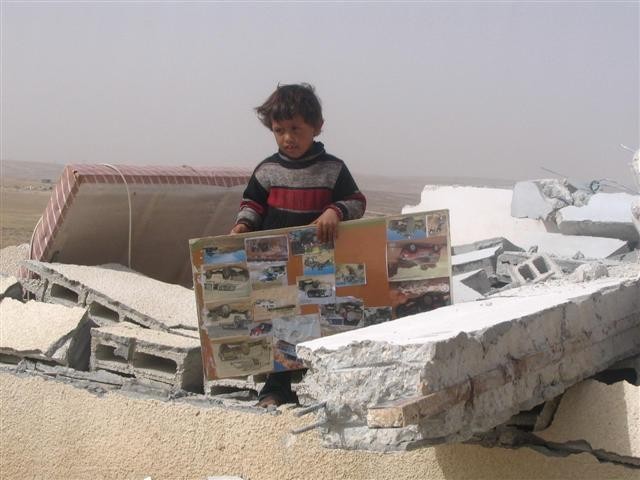
22 September 2006
To:
Mr. Miloon Kothari
Special Rapporteur on adequate housing as a component of the right to an adequate standard of living
Mr. Rodolfo Stavenhagen
Special Rapporteur on the situation of human rights and fundamental freedoms of indigenous people
Appeal for an urgent action: To halt the intention of the Israeli government to destroy an entire indigenous Bedouin village in the Negev (Southern Israel)
The village of A-Sira is home to 350 indigenous Arab-Bedouins. On September 7th, approximately 200 police officers and inspectors raided the village and posted 45 demolition notices as well as an additional six houses that had been given a prior warning. This means that all of the houses and structures in the village are to be torn down. As of today, no alternative housing solution has been found for the residents
1. General Information
The Indigenous Arab-Bedouins are a unique community that has lived in the Negev for centuries. In 1948, they constituted the vast majority of the population of the Negev. However, after the establishment of Israel, only a small fraction of the population was left in the Negev, the rest having left or been expelled to Jordan and Egypt. The Israeli authorities did not recognize the indigenous Arab-Bedouins' traditional ownership rights. Dispossessed of the lands they had owned for centuries, today the 160,000 Arab-Bedouins are the most disadvantaged citizens in Israel. Almost half of the indigenous Arab-Bedouin citizens live in seven failing government-planned towns. The remainder lives in 45 villages unrecognized by the government. These villages do not appear on the official maps of Israel and do not receive basic services such as running water, electricity, garbage collection, etc. One of these villages is the unrecognized village of A-Sira.
One of the principal methods by which the government hopes to resettle this indigenous community in the townships is by demolishing their 'illegal' houses in the unrecognized villages, and by not providing any avenues for legal construction within the villages. During the past three years alone, 560 houses were demolished in the unrecognized villages, leaving thousands of people homeless.
2. Identity of the persons concerned
The village of A-Sira is home to 350 indigenous Arab-Bedouins. The village is located near the Nevatim Air-Force base (10 km southwest of the city of Arad). The 50 houses of the village stretch over 4 square kilometers. The residents have lived in this area for generations, throughout the Ottoman and British mandates. Seven different wells and cisterns, as well as documents of land acquisition during the Ottoman rule, prove their connection to the place.
3. Information Regarding the Alleged Violations
In 1980, the Israeli authorities passed “The Negev Land Acquisition (Peace Treaty With Egypt) Law" that allowed the expropriation of the village lands for the purpose of establishing the Nevatim Air-Force Base. Although the village lies outside the air force base, all of the village lands were declared a military zone. The residents were not informed of this decision and they gave no consent to this decision.
Three months ago, dozens of police officers and officials from the Ministry of the Interior posted seven warning notices of impending house demolitions. The residents of the village went to court to fight the injunction. One house was destroyed by the residents themselves after one of the judges asked if anyone was living in the house. This house was being constructed for a divorced woman with four children who suffer from a number of health problems (retardation, deafness). After the judge was told that the house was under construction, he ordered it to be demolished. The woman and her children are now living in a makeshift lean-to.
On September 7th, approximately 200 police officers and inspectors returned to the village and posted 45 demolition notices as well as an additional six houses that had been given a prior warning. This means that all of the houses and structures in the village are to be torn down. As of today, no alternative housing solution has been found for the residents. The building inspector in the Ministry of the Interior asserts that his job is just to demolish the houses. The Bedouin Authority, which is responsible for settling this population, has not offered any concrete solutions to the problem.
When the injunctions were distributed on September 7th, a pregnant woman in her sixth month, who is a mother of five, had an anxiety attack. She was taken to the hospital where she gave birth to a premature infant. The baby died after several days, on September 17th.
4. Steps Taken by the Victims
The residents went to all of the authorities that are connected to the topic and had initiated a number of meetings with government officials.
On June 4th, 2006 - there was a meeting with the commander of the air force base which is next to the village. He told the villagers that although there is a plan to enlarge the base, there is no plan to enlarge it in the direction of the village and that the base does not need their land.
On June 6th, 2006 – A meeting was held with Mr. Ilan Sagy, the construction inspector of the Ministry of Interior for the southern region. He promised to wait three months before demolishing the homes. He noted that he could not make any recommendations or suggestions for housing since he is in charge of demolitions.
On June 8th, 2006 – A meeting was held with Mr. Ilan Yifrach, of the Bedouin Authority, about housing solutions. No immediate solution was put forth. The idea was raised to move the residents to a future settlement, called Mar'it, or to the town of Rahat, which is located 40 kilometers from A-Sira.
On July 7th, 2006 – A meeting was held with Mr. Ya'acov Katz, the head of the Bedouin Authority. He said that he had no solution and that he would check the options of Mar'it, Rahat and Lakia (another Bedouin town). He asked the village representatives to consider asking one of the clans in Lakia for permission to move there. This was a clear attempt to create conflict between the Bedouin tribes, in order to divide and conquer.
All of these meetings made it clear to the residents of A-Sira that the State of Israel has no real housing solution for them. The attempt to destroy the village and to expel the residents from their ancestral lands clearly violates the right to housing, land ownership and the indigenous rights of the villagers. An urgent action is needed in order to prevent the danger that is hanging over the heads of the 350 residents of the village. They may find themselves with no roofs over their heads in the very near future.
5. Identity of the Persons Submitting the Form
Village Committee of A-Sira
Mr Halil Al-Amour
Mr. Ahmad Al Nasasra
Tel: +972-52-2700365
Email: ycantmeetu@hotmail.com
Negev Coexistence Forum for Civil Equality
Mr. Ariel Dloomy
Tel: +972-50-7701118 Fax: +972-8-9390185
Email: ariel@dukium.org
By e-mail: urgent-action@ohchr.org
By fax: +41 22 917 90 06
CAMPAIGNS TARGETING THE OCCUPATION
(Delivered by Angela Godfrey-Goldstein at the recent UN International Conference of Civil Society in Support of the Palestinian People, in Geneva – September 7/8)
Israel’s war on Lebanon – its blitzkrieg - has resulted in an almost unprecedented level of international protest, activist organising and even rebuke of Israeli policies from national governments. The feeling is not only that enough is enough, but time is running out for the moderates.
It has also increased the peacemaking role of the United Nations and the EU, whilst possibly weakening the United States’ position as regional power-broker, because it championed and armed a defeated Israel, which is now less of a strategic ally. Since neither side “won,” the hope is that war itself is now seen to be increasingly fruitless, as is unilateralism.
The Israeli government is somewhat paralysed by its defeat, so it’s vital for us all to work fast towards solving the situation, which could spiral further downwards, as predicted by the Pentagon’s Quadrennial Defence Plan (a 20 year war on Islam), or as engineered by an itchy Israeli defence establishment (situated in the midst of civilian Tel Aviv) which wants to try to reclaim its image of deterrence. Amir Peretz, previously tipped as a future prime minister, is at an all time low, and may be replaced as party leader and defence minister. Some predict national elections within a year. We have a window here.
So we must now be even more focused in saying no to occupation, no to war and militarism, no to unilateralism, no to colonialism and no to racism. If we shilly-shally on this, we could find ourselves in a Christian Zionist wet dream of Rapture, otherwise translating as nuclear holocaust. Here in civilised Geneva that sounds sensationalist scaremongering, but on the ground there’s talk of Al Qaida muscling into the chaos Israel has been part of creating in Gaza.
And now Israeli civilians know they’re front-line participants in war, as never before, and missiles may come at them soon over that so-called Security Wall. Those of us against the Wall were talking of rockets and tunnels years ago.
Whilst we can’t blame Israel for all the Palestinians’ ills, Occupation is at the heart of the matter. At a UN meeting in Vienna, Israeli Member of Knesset Ms. Colette Avital said to me that the wretched checkpoints are the problem. No, Ms. Avital, the settlers and landgrab of settlement expansion, serviced by the checkpoints, apartheid road system, Wall, permit system, home demolitions and Closure – the Occupation in all its misery, its whole Matrix of Control – is the problem. And so is the inherent racism that views another people as lesser humans, with a lesser value for life, and deserving less from life. Coming from a people whose religion teaches that God created everything on the earth, they singularly fail to value LIFE and the sanctity of all life. The sacred nature of all beings, all equally created by whatever we call God.
I was recently told by someone connected to our Israeli Ministry of Foreign Affairs that “first we have to neutralise Lebanon and Syria, and then we can make peace with the Palestinians and end the Occupation.” If the Israeli government’s game plan, neutralisation, means further massive aerial bombardment and attacks by F-16 and Apache helicopters, cluster bombs, uranium depleted or phosphorous bombs, it’s a further slide down the slippery slope into regional war; this will also translate into terror attacks elsewhere, maybe even here. What a helluva policy! Maybe Olmert’s declaration yesterday that he will soon be holding talks with Mahmoud Abbas means that even that policy is already passé. Insha’allah. But let us not get our hopes up, especially when we see what the facts on the ground are.
So what about the campaigns? Significantly, one example: the MoveOn internet campaign ran a Ceasefire Petition garnering 300,000 signatures in three days, demanding an immediate ceasefire, which it presented to the Security Council. They’re now mobilising their extensive internet resources to press for a return to peace negotiations between Israel and Palestine, an end to Occupation and a viable Palestinian state. A few years ago, I wrote to them asking them to work on the Israeli-Palestinian conflict and received a negative response. Now the time is right, and it’s become unavoidable.
Recently there was even a unanimous statement of the Irish government’s Joint Committee on Foreign Affairs, condemning civilian deaths, the damage done to civilian infrastructure in Lebanon on such a scale as to render over 750,000 people homeless, the attack on a UN outpost which killed four peacekeepers, and the slaughter at Qana. It also called for an immediate ceasefire.
Critically, that call recommended:
“That Ireland raise at the next meeting of the EU Council of Ministers the implementation of sanctions on Israel under the terms of Article II of the Euromed Trade Agreement on grounds of human rights abuses;"
"That consideration be given to taking legal action against Israel for compensation for its killing of UN personnel and the civilian population and destruction of facilities;"
It "condemned the seizure of water resources by Israel in the region and urged the UN to establish a permanent specialized team to control and ensure the fair distribution of all water resources."
The Irish further "called for a rejection of militarism and a sustained engagement by the European Union and the UN on a set of political proposals as would support the establishment of a viable contiguous Palestinian state, and would enable true security to be provided for Israel based on accepted borders and withdrawal from occupied territories;"
"For the Irish Government to advocate at EU and UN level the establishment of an internationally sponsored Peace Process, with a permanent secretariat, to bring together all sides including Israel and the United States for negotiations.”
One thinks, too, of past anti-war on Iraq street protests, huge waves of demonstrators reaching unprecedented numbers, but which failed to stop the Occupation of Iraq. Despite failing to leverage governments, who remained steadfastly deaf to their own civil society’s huge pressure, nonetheless those massive demonstrations underscored the claim that the war in Iraq was immoral, illegal under international law, unnecessary, denied all principles of democracy (proving the lie that the war was an attempt to introduce democracy to the Middle East) and – in Harold Pinter’s famous diatribe delivered when he received the Nobel Prize for Literature –
“was a bandit act, an act of blatant state terrorism, demonstrating absolute contempt for the concept of international law. The invasion was an arbitrary military action inspired by a series of lies upon lies and gross manipulation of the media and therefore of the public; an act intended to consolidate American military and economic control of the Middle East masquerading - as a last resort - all other justifications having failed to justify themselves - as liberation. A formidable assertion of military force responsible for the death and mutilation of thousands and thousands of innocent people.”
Post-9/11, campaigning has become – at least in the short-term – increasingly frustrating because even when civil society is in uproar, as recently when watching the conflict in Lebanon and Israel on its TV screens or reading personal testimony by articulate Lebanese bloggers, world governments stood by for too long and allowed it to happen. A BBC journalist covering Gaza said to me, in despair, that he couldn’t understand why the world was allowing it all to happen. Certainly there are many times when we campaigners ask ourselves why don’t people care about Palestine? Is it that they don’t value human rights? Or international law? Real democracy? Freedom? Maybe life itself? Here in Geneva, the birthplace after the 2nd World War of the Geneva Convention and home of the Intnl. Committee of the Red Cross, we hope for recognition by the Swiss that the benchmarks must be reclaimed and the standards regained, so that they have value at all.
Yet, as I said, from around the world, we now hear increasingly in this post-War period of boycotts, divestment actions and even talk of international sanctions, as part of a movement towards peacekeeping and peacemaking, increasingly centred on Europe and the UN.
Our work in reframing the conflict and ending its central cause, the Occupation, has become infinitely easier now that Israel is so patently seen not to be the victim, a role it’s always played to the world stage. Israel’s militarism has been totally exposed, with its lack of regard for such niceties as the Geneva Convention, human rights or international law, or even proportionality. Now the asymmetry is out in the open, just as the huge infrastructure on the ground – all those settlement cities – cannot be hidden. And the world has seen Israel as a huge thug, demolishing a neighbouring country’s infrastructure, while collectively punishing the Lebanese and the Gazans and West Bankers. Wherever Israelis go today, they must know they are hated for that. They can’t use the old rebuttal of “anti-semitism” when it’s so obvious that criticism has nothing to do with anti-semitism. (A useful joke to deflate some of that “Jewish lobby” knee-jerk: ‘Once upon a time, an anti-semite was someone who hated Jews. Today an anti-semite is anyone the Jews hate!’)
The focus must now be to continue to highlight facts on the ground – which are increasingly obvious – almost half a million settlers are not easy to disguise. Nor is the huge Wall snaking all over the West Bank. We at ICAHD have for many years been guiding diplomats (including heads of mission or delegations), international journalists, aid workers, church groups, foreign parliamentarians and many members of civil society and become partners in co-ordinated campaigns of advocacy (for example every year rebuilding a demolished home, as an act of civil disobedience, with international volunteers). We’re developing an anti-apartheid campaign, and work to target power, through education, lobbying and advocacy. We were the first Israeli NGO to support BDS – boycott, divestment and sanctions. Our organisation works closely with Palestinian counterparts and has three Palestinian staff members. Our grassroots work actively supports Palestinians, whether by taking demolition cases to court, or fighting the route of the Wall, or by taking guided tours also to the Negev or Galilee or Lod, to show what The Only Democracy in the Middle East is really all about. Trust me, it’s not about democracy. Any more than the Israeli Defence Force is about defence. Or the Civil Administration civilian. Or Jerusalem an undivided city.
The idea of boycott is a way for civil society to make its feelings felt. It isn’t focused against Israel per se, but against its Occupation policies – policies which even Ariel Sharon said were unsustainable. Once the Occupation ends, Israel will be able to rejoin the international community. But it can't expect to carry on a normal life (with film festivals, participation in international cultural events, European league football, the Olympic Games, Eurovision and the rest) while it blatantly disregards human rights and international law, and practices racist policies which sink it ever deeper into corruption, anarchy and moral and ethical stagnation. We have to learn how to say NO. That’s all.
Trade unions around the world are becoming increasingly involved – as they did in the days of anti-apartheid. Civil society organisations are growing in number and coherence, organisation and strategy. Leading figures such as film director Ken Loach are coming out against the Occupation, together with Israeli and Palestinian film makers, calling for Israel to be culturally boycotted at film festivals and other artistic events. Other artists are gradually plucking up courage to go public in criticism of Israeli policies (300 prominent British Jews signed a public statement in the Times of London, denouncing the Lebanon debacle). Palestinians also tell of leaders of the American Jewish community who say they are beginning to understand what a monster they have helped to create. And so one hears more and more voices in the Jewish world in Europe or North America starting to push for an end to Occupation; recently South African minister Ronnie Kasrils explicitly condemned Israel’s apartheid policies, and South Africa is now working to bring to trial any South African Israelis who served in Lebanon.
Racism, fascism and colonialism have never been the Jewish way, so the rise of politicians such as Avigdor Lieberman – an outright fascist – should be deeply troubling to those who cherish an idealised vision of Israel. Settlement expansion has been so vast and so illegal, even under Israel’s laws, that it can no longer be disguised. When between half a million to one million Israelis have chosen to leave, and one in three are under the poverty level, including 40% of the country’s holocaust survivors (170,000 people), and when increasing numbers of Israelis are on Viagra or other drugs, even the naysayers must stop and think. And the Gaza withdrawal sent a message to the right-wing settlement movement that it had failed in its mission to redeem the biblical land of Israel, that that dream is over. And that a Palestinian state is being born. The question of course is whether Condoleezza Rice’s New Middle East is having birthpangs or is aborting, stillborn – cut off from an oxygen supply by Israeli closure and international sanctions.
In England, the United States and Belgium, human rights lawyers are taking a stand against Israelis whom they accuse of war crimes, and that’s only beginning. There’s now serious discussion about sending international peacekeepers not just to South Lebanon, but also into Palestine.
Some more ground rules in this campaign:
Israel is the strong party in the conflict. Her people perceive themselves as weak, but the truth is it’s the 4th largest army in the world, the 4th largest nuclear power, the 3rd largest arms producer. It is not David, it is Goliath. And we have to reframe this so it’s clear.
The Occupation is pro-active, not defensive. The settlements, apartheid roads, the Wall, home demolitions, land expropriation and closure have nothing to do with security or defence and everything to do with control, suppression, ethnic transfer and de-development of Palestine, while Israel claims the entire country and denies Palestine a viable independent state.
We have to remember that only conflict resolution, based on international law and principles of social and economic justice, will end all this. Military win-lose thinking (such as was the rule during the Oslo years) only escalates the violence, just as militarism per se is always an escalating force. (Some say Weapons of Mass Destruction are firmly in the hands of terrorists - naming George W. Bush and others as state terrorists.)
Both the Israeli and Palestinian publics want an end to Occupation, but Israelis aren’t campaigning in any numbers for this. They’ve bought into the lies of Ehud Barak that the Palestinians don’t want peace, so only international pressure will bring change.
The Palestinians and the Arab world support a just peace. The Beirut Declaration and the Prisoners’ Document (even the Geneva Initiative) prove the lie of Israel which says there’s no partner.
We believe that Israel isn’t going to end the Occupation by pressure from within. Only international pressure, coming from civil society, will tip the balance, as it did for South Africa. Whilst George W. Bush has certainly managed with his War on Terror to stem the power of civil society to leverage governments, he’s on the way out and we must now work to regain democracy. As Arundhati Roy says, in THE ORDINARY PERSON’S GUIDE TO EMPIRE: “The people of the world do not need to choose between a Malevolent Mickey Mouse and the Mad Mullahs.”
We need to get serious about funding, about co-ordination, maybe about developing leaders (for we don’t have a Mandela, Gandhi, Martin Luther King, Dalai Lama or Jimmy Carter to lead this). We must develop focused, strategic campaigns – such as a campaign to apply the Fourth Geneva Convention to the Territories, or a campaign to prevent governments trading in arms with Israel, and of course BDS. Boycott, divestment and sanctions. Having lived in South Africa under apartheid, I can tell you that Israel’s policies towards Palestinians are far far worse than the policies of the South African apartheid regime. We have to fight that Israeli apartheid, and expose it for what it is, and in so doing liberate even the Israeli people themselves, who suffer as oppressors, albeit less than Palestinians under occupation.
As we gear up to the 40th year of Occupation of the West Bank and Gaza (which has not yet been liberated at all), we must use that date. And the following year – 2008, the 60th anniversary of the Naqba, the Disaster. We must hear from refugees. Refugees everywhere. Lebanon. Syria. Jordan. Egypt. Gaza. Israel. The West Bank. Or elsewhere in the Palestinian "diaspora".
And if those of us in the conflict zone can’t provide leadership, then international civil society must take on that responsibility, too. As Jeff Halper of ICAHD says: “An approach that generates a pro-active strategy of advocacy has the ability to become a global movement akin to the anti-apartheid struggle. Under Palestinian guidance, in co-ordination with the Israeli peace movement and international activists and advocates, it must provide direction, effective forums for strategizing (such as this), reframing and the formulation of focused and strategic campaigns. It must impart a vision, principles, red lines and alternative scenarios. These are critical steps at this historical moment. As the old slogan has it: ‘When the people lead, the leaders follow.’”
Israel’s war on Lebanon – its blitzkrieg - has resulted in an almost unprecedented level of international protest, activist organising and even rebuke of Israeli policies from national governments. The feeling is not only that enough is enough, but time is running out for the moderates.
It has also increased the peacemaking role of the United Nations and the EU, whilst possibly weakening the United States’ position as regional power-broker, because it championed and armed a defeated Israel, which is now less of a strategic ally. Since neither side “won,” the hope is that war itself is now seen to be increasingly fruitless, as is unilateralism.
The Israeli government is somewhat paralysed by its defeat, so it’s vital for us all to work fast towards solving the situation, which could spiral further downwards, as predicted by the Pentagon’s Quadrennial Defence Plan (a 20 year war on Islam), or as engineered by an itchy Israeli defence establishment (situated in the midst of civilian Tel Aviv) which wants to try to reclaim its image of deterrence. Amir Peretz, previously tipped as a future prime minister, is at an all time low, and may be replaced as party leader and defence minister. Some predict national elections within a year. We have a window here.
So we must now be even more focused in saying no to occupation, no to war and militarism, no to unilateralism, no to colonialism and no to racism. If we shilly-shally on this, we could find ourselves in a Christian Zionist wet dream of Rapture, otherwise translating as nuclear holocaust. Here in civilised Geneva that sounds sensationalist scaremongering, but on the ground there’s talk of Al Qaida muscling into the chaos Israel has been part of creating in Gaza.
And now Israeli civilians know they’re front-line participants in war, as never before, and missiles may come at them soon over that so-called Security Wall. Those of us against the Wall were talking of rockets and tunnels years ago.
Whilst we can’t blame Israel for all the Palestinians’ ills, Occupation is at the heart of the matter. At a UN meeting in Vienna, Israeli Member of Knesset Ms. Colette Avital said to me that the wretched checkpoints are the problem. No, Ms. Avital, the settlers and landgrab of settlement expansion, serviced by the checkpoints, apartheid road system, Wall, permit system, home demolitions and Closure – the Occupation in all its misery, its whole Matrix of Control – is the problem. And so is the inherent racism that views another people as lesser humans, with a lesser value for life, and deserving less from life. Coming from a people whose religion teaches that God created everything on the earth, they singularly fail to value LIFE and the sanctity of all life. The sacred nature of all beings, all equally created by whatever we call God.
I was recently told by someone connected to our Israeli Ministry of Foreign Affairs that “first we have to neutralise Lebanon and Syria, and then we can make peace with the Palestinians and end the Occupation.” If the Israeli government’s game plan, neutralisation, means further massive aerial bombardment and attacks by F-16 and Apache helicopters, cluster bombs, uranium depleted or phosphorous bombs, it’s a further slide down the slippery slope into regional war; this will also translate into terror attacks elsewhere, maybe even here. What a helluva policy! Maybe Olmert’s declaration yesterday that he will soon be holding talks with Mahmoud Abbas means that even that policy is already passé. Insha’allah. But let us not get our hopes up, especially when we see what the facts on the ground are.
So what about the campaigns? Significantly, one example: the MoveOn internet campaign ran a Ceasefire Petition garnering 300,000 signatures in three days, demanding an immediate ceasefire, which it presented to the Security Council. They’re now mobilising their extensive internet resources to press for a return to peace negotiations between Israel and Palestine, an end to Occupation and a viable Palestinian state. A few years ago, I wrote to them asking them to work on the Israeli-Palestinian conflict and received a negative response. Now the time is right, and it’s become unavoidable.
Recently there was even a unanimous statement of the Irish government’s Joint Committee on Foreign Affairs, condemning civilian deaths, the damage done to civilian infrastructure in Lebanon on such a scale as to render over 750,000 people homeless, the attack on a UN outpost which killed four peacekeepers, and the slaughter at Qana. It also called for an immediate ceasefire.
Critically, that call recommended:
“That Ireland raise at the next meeting of the EU Council of Ministers the implementation of sanctions on Israel under the terms of Article II of the Euromed Trade Agreement on grounds of human rights abuses;"
"That consideration be given to taking legal action against Israel for compensation for its killing of UN personnel and the civilian population and destruction of facilities;"
It "condemned the seizure of water resources by Israel in the region and urged the UN to establish a permanent specialized team to control and ensure the fair distribution of all water resources."
The Irish further "called for a rejection of militarism and a sustained engagement by the European Union and the UN on a set of political proposals as would support the establishment of a viable contiguous Palestinian state, and would enable true security to be provided for Israel based on accepted borders and withdrawal from occupied territories;"
"For the Irish Government to advocate at EU and UN level the establishment of an internationally sponsored Peace Process, with a permanent secretariat, to bring together all sides including Israel and the United States for negotiations.”
One thinks, too, of past anti-war on Iraq street protests, huge waves of demonstrators reaching unprecedented numbers, but which failed to stop the Occupation of Iraq. Despite failing to leverage governments, who remained steadfastly deaf to their own civil society’s huge pressure, nonetheless those massive demonstrations underscored the claim that the war in Iraq was immoral, illegal under international law, unnecessary, denied all principles of democracy (proving the lie that the war was an attempt to introduce democracy to the Middle East) and – in Harold Pinter’s famous diatribe delivered when he received the Nobel Prize for Literature –
“was a bandit act, an act of blatant state terrorism, demonstrating absolute contempt for the concept of international law. The invasion was an arbitrary military action inspired by a series of lies upon lies and gross manipulation of the media and therefore of the public; an act intended to consolidate American military and economic control of the Middle East masquerading - as a last resort - all other justifications having failed to justify themselves - as liberation. A formidable assertion of military force responsible for the death and mutilation of thousands and thousands of innocent people.”
Post-9/11, campaigning has become – at least in the short-term – increasingly frustrating because even when civil society is in uproar, as recently when watching the conflict in Lebanon and Israel on its TV screens or reading personal testimony by articulate Lebanese bloggers, world governments stood by for too long and allowed it to happen. A BBC journalist covering Gaza said to me, in despair, that he couldn’t understand why the world was allowing it all to happen. Certainly there are many times when we campaigners ask ourselves why don’t people care about Palestine? Is it that they don’t value human rights? Or international law? Real democracy? Freedom? Maybe life itself? Here in Geneva, the birthplace after the 2nd World War of the Geneva Convention and home of the Intnl. Committee of the Red Cross, we hope for recognition by the Swiss that the benchmarks must be reclaimed and the standards regained, so that they have value at all.
Yet, as I said, from around the world, we now hear increasingly in this post-War period of boycotts, divestment actions and even talk of international sanctions, as part of a movement towards peacekeeping and peacemaking, increasingly centred on Europe and the UN.
Our work in reframing the conflict and ending its central cause, the Occupation, has become infinitely easier now that Israel is so patently seen not to be the victim, a role it’s always played to the world stage. Israel’s militarism has been totally exposed, with its lack of regard for such niceties as the Geneva Convention, human rights or international law, or even proportionality. Now the asymmetry is out in the open, just as the huge infrastructure on the ground – all those settlement cities – cannot be hidden. And the world has seen Israel as a huge thug, demolishing a neighbouring country’s infrastructure, while collectively punishing the Lebanese and the Gazans and West Bankers. Wherever Israelis go today, they must know they are hated for that. They can’t use the old rebuttal of “anti-semitism” when it’s so obvious that criticism has nothing to do with anti-semitism. (A useful joke to deflate some of that “Jewish lobby” knee-jerk: ‘Once upon a time, an anti-semite was someone who hated Jews. Today an anti-semite is anyone the Jews hate!’)
The focus must now be to continue to highlight facts on the ground – which are increasingly obvious – almost half a million settlers are not easy to disguise. Nor is the huge Wall snaking all over the West Bank. We at ICAHD have for many years been guiding diplomats (including heads of mission or delegations), international journalists, aid workers, church groups, foreign parliamentarians and many members of civil society and become partners in co-ordinated campaigns of advocacy (for example every year rebuilding a demolished home, as an act of civil disobedience, with international volunteers). We’re developing an anti-apartheid campaign, and work to target power, through education, lobbying and advocacy. We were the first Israeli NGO to support BDS – boycott, divestment and sanctions. Our organisation works closely with Palestinian counterparts and has three Palestinian staff members. Our grassroots work actively supports Palestinians, whether by taking demolition cases to court, or fighting the route of the Wall, or by taking guided tours also to the Negev or Galilee or Lod, to show what The Only Democracy in the Middle East is really all about. Trust me, it’s not about democracy. Any more than the Israeli Defence Force is about defence. Or the Civil Administration civilian. Or Jerusalem an undivided city.
The idea of boycott is a way for civil society to make its feelings felt. It isn’t focused against Israel per se, but against its Occupation policies – policies which even Ariel Sharon said were unsustainable. Once the Occupation ends, Israel will be able to rejoin the international community. But it can't expect to carry on a normal life (with film festivals, participation in international cultural events, European league football, the Olympic Games, Eurovision and the rest) while it blatantly disregards human rights and international law, and practices racist policies which sink it ever deeper into corruption, anarchy and moral and ethical stagnation. We have to learn how to say NO. That’s all.
Trade unions around the world are becoming increasingly involved – as they did in the days of anti-apartheid. Civil society organisations are growing in number and coherence, organisation and strategy. Leading figures such as film director Ken Loach are coming out against the Occupation, together with Israeli and Palestinian film makers, calling for Israel to be culturally boycotted at film festivals and other artistic events. Other artists are gradually plucking up courage to go public in criticism of Israeli policies (300 prominent British Jews signed a public statement in the Times of London, denouncing the Lebanon debacle). Palestinians also tell of leaders of the American Jewish community who say they are beginning to understand what a monster they have helped to create. And so one hears more and more voices in the Jewish world in Europe or North America starting to push for an end to Occupation; recently South African minister Ronnie Kasrils explicitly condemned Israel’s apartheid policies, and South Africa is now working to bring to trial any South African Israelis who served in Lebanon.
Racism, fascism and colonialism have never been the Jewish way, so the rise of politicians such as Avigdor Lieberman – an outright fascist – should be deeply troubling to those who cherish an idealised vision of Israel. Settlement expansion has been so vast and so illegal, even under Israel’s laws, that it can no longer be disguised. When between half a million to one million Israelis have chosen to leave, and one in three are under the poverty level, including 40% of the country’s holocaust survivors (170,000 people), and when increasing numbers of Israelis are on Viagra or other drugs, even the naysayers must stop and think. And the Gaza withdrawal sent a message to the right-wing settlement movement that it had failed in its mission to redeem the biblical land of Israel, that that dream is over. And that a Palestinian state is being born. The question of course is whether Condoleezza Rice’s New Middle East is having birthpangs or is aborting, stillborn – cut off from an oxygen supply by Israeli closure and international sanctions.
In England, the United States and Belgium, human rights lawyers are taking a stand against Israelis whom they accuse of war crimes, and that’s only beginning. There’s now serious discussion about sending international peacekeepers not just to South Lebanon, but also into Palestine.
Some more ground rules in this campaign:
Israel is the strong party in the conflict. Her people perceive themselves as weak, but the truth is it’s the 4th largest army in the world, the 4th largest nuclear power, the 3rd largest arms producer. It is not David, it is Goliath. And we have to reframe this so it’s clear.
The Occupation is pro-active, not defensive. The settlements, apartheid roads, the Wall, home demolitions, land expropriation and closure have nothing to do with security or defence and everything to do with control, suppression, ethnic transfer and de-development of Palestine, while Israel claims the entire country and denies Palestine a viable independent state.
We have to remember that only conflict resolution, based on international law and principles of social and economic justice, will end all this. Military win-lose thinking (such as was the rule during the Oslo years) only escalates the violence, just as militarism per se is always an escalating force. (Some say Weapons of Mass Destruction are firmly in the hands of terrorists - naming George W. Bush and others as state terrorists.)
Both the Israeli and Palestinian publics want an end to Occupation, but Israelis aren’t campaigning in any numbers for this. They’ve bought into the lies of Ehud Barak that the Palestinians don’t want peace, so only international pressure will bring change.
The Palestinians and the Arab world support a just peace. The Beirut Declaration and the Prisoners’ Document (even the Geneva Initiative) prove the lie of Israel which says there’s no partner.
We believe that Israel isn’t going to end the Occupation by pressure from within. Only international pressure, coming from civil society, will tip the balance, as it did for South Africa. Whilst George W. Bush has certainly managed with his War on Terror to stem the power of civil society to leverage governments, he’s on the way out and we must now work to regain democracy. As Arundhati Roy says, in THE ORDINARY PERSON’S GUIDE TO EMPIRE: “The people of the world do not need to choose between a Malevolent Mickey Mouse and the Mad Mullahs.”
We need to get serious about funding, about co-ordination, maybe about developing leaders (for we don’t have a Mandela, Gandhi, Martin Luther King, Dalai Lama or Jimmy Carter to lead this). We must develop focused, strategic campaigns – such as a campaign to apply the Fourth Geneva Convention to the Territories, or a campaign to prevent governments trading in arms with Israel, and of course BDS. Boycott, divestment and sanctions. Having lived in South Africa under apartheid, I can tell you that Israel’s policies towards Palestinians are far far worse than the policies of the South African apartheid regime. We have to fight that Israeli apartheid, and expose it for what it is, and in so doing liberate even the Israeli people themselves, who suffer as oppressors, albeit less than Palestinians under occupation.
As we gear up to the 40th year of Occupation of the West Bank and Gaza (which has not yet been liberated at all), we must use that date. And the following year – 2008, the 60th anniversary of the Naqba, the Disaster. We must hear from refugees. Refugees everywhere. Lebanon. Syria. Jordan. Egypt. Gaza. Israel. The West Bank. Or elsewhere in the Palestinian "diaspora".
And if those of us in the conflict zone can’t provide leadership, then international civil society must take on that responsibility, too. As Jeff Halper of ICAHD says: “An approach that generates a pro-active strategy of advocacy has the ability to become a global movement akin to the anti-apartheid struggle. Under Palestinian guidance, in co-ordination with the Israeli peace movement and international activists and advocates, it must provide direction, effective forums for strategizing (such as this), reframing and the formulation of focused and strategic campaigns. It must impart a vision, principles, red lines and alternative scenarios. These are critical steps at this historical moment. As the old slogan has it: ‘When the people lead, the leaders follow.’”
Subscribe to:
Posts (Atom)